A particle having some charge is projected in $x-y$ plane with a speed of $5\ m/s$ in a region having uniform magnetic field along $z-$ axis. Which of the following cannot be the possible value of velocity at any time ?
Easy
Download our app for free and get started
Magnetic field cannot change speed and since magnetic field is along $z$ axis, velocity cannot be in $z$ axis at any instant i.e.. it cannot have $\hat k$ component.

Download our appand get started for free
Experience the future of education. Simply download our apps or reach out to us for more information. Let's shape the future of learning together!No signup needed.*
Similar Questions
- 1The resistance of a galvanometer is $50\,\Omega $ and it requires $2\,\mu A$ per two division deflection. The value of the shunt required in order to convert this galvanometer into ammeter of range $5\,A$ is (The number of divisions on the galvanometer scale on one side is $30$)View Solution
- 2A current of $0.1\, A$ circulates around a coil of $100$ $turns$ and having a radius equal to $5\,cm$. The magnetic field set up at the centre of the coil is ($\mu_0 = 4\pi \times 10^{-7} weber/amp-metre$)View Solution
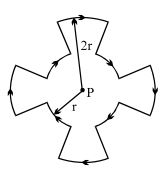
- 3A current $I$ flows around a closed path in the horizontal plane of the circle as shown in the figure. The path consists of eight arcs with alternating radii $r$ and $2r$. Each segment of arc subtends equal angle at the common centre $P.$ The magnetic field produced by current path at point $P$ isView Solution
- 4The resistance of $1\, A$ ammeter is $0.018\,\Omega $. To convert it into $10\, A$ ammeter, the shunt resistance required will beView Solution
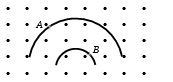
- 5Two particles $A$ and $B$ of masses ${m_A}$ and ${m_B}$ respectively and having the same charge are moving in a plane. A uniform magnetic field exists perpendicular to this plane. The speeds of the particles are ${v_A}$ and ${v_B}$ respectively, and the trajectories are as shown in the figure. ThenView Solution
- 6A closely wound solenoid $80\; cm$ long has $5$ layers of windings of $400$ turns each. The diameter of the solenoid is $1.8\; cm$. If the current carried is $8.0\; A$, estimate the magnitude of $B$ inside the solenoid near its centre.View Solution
- 7A proton, an electron, and a Helium nucleus, have the same energy. They are in circular orbitals in a plane due to magnetic field perpendicular to the plane. Let $r_p, r_e$ and $r_{He}$ be their respective radii, thenView Solution
- 8An electron revolves around nucleus with rotational frequency $'f'$ in circular orbit, due to this magnetic induction produced at nucleus position is $'B'$ then radius of circular orbit is directly proportional toView Solution
- 9The ratio of the magnetic field at the centre of a current carrying circular coil to its magnetic moment is $'\alpha '.$ If the current and radius both are doubled then new ratio will becomeView Solution
- 10Statement $-1$ : Path of the charge particle may be straight line in uniform magnetic field.View Solution
Statement $-2$ : Path of the charge particle is decided by the angle between its velocity and the magnetic force working on it