The minimum intensity of sound is zero at a point due to two sources of nearly equal frequencies, when
Easy
Download our app for free and get started
(c) If two waves of nearly equal frequency superpose,
they give beats if they both travel in straight line and ${I_{\min }} = 0$
if they have equal amplitudes.

Download our appand get started for free
Experience the future of education. Simply download our apps or reach out to us for more information. Let's shape the future of learning together!No signup needed.*
Similar Questions
- 1The intensity level due to two waves of the same frequency in a given medium are $1\, bel$ and $5\, bel$. Then the ratio of amplitudes isView Solution
- 2View SolutionA closed organ pipe and an open organ pipe are tuned to the same fundamental frequency. What is the ratio of lengths
- 3${v_1}$ and ${v_2}$ are the velocities of sound at the same temperature in two monoatomic gases of densities ${\rho _1}$ and ${\rho _2}$ respectively. If $\frac{\rho _1}{\rho _2} = \frac{1}{4}$ then the ratio of velocities ${v_1}$ and ${v_2}$ will beView Solution
- 4A string wave equation is given $y=0.002 \sin (300 t-15 x)$ and mass density is $\mu=\frac{0.1\, kg }{m}$. Then find the tension in the string, (in $N$)View Solution
- 5An organ pipe $P_1$ closed at one end vibrating in its first overtone. Another pipe $P_2$ open at both ends is vibrating in its third overtone. They are in a resonance with a given tuning fork. The ratio of the length of $P_1$ to that of $P_2$ is :View Solution
- 6View SolutionQuality depends on
- 7In a test of subsonic Jet flies over head at an altitude of $100\,\, m$. The sound intensity on the ground as the Jet passes overhead is $160 \,\,dB$. At what altitude should the plane fly so that the ground noise is not greater than $120\,\, dB.$View Solution
- 8View SolutionWhich of the following statements are wrong about the velocity of sound in air:
- 9Column $I$ shows four systems, each of the same length $L$, for producing standing waves. The lowest possible natural frequency of a system is called its fundamental frequency, whose wavelength is denoted as $\lambda_{ f }$. Match each system with statements given in Column $II$ describing the nature and wavelength of the standing waves.View Solution
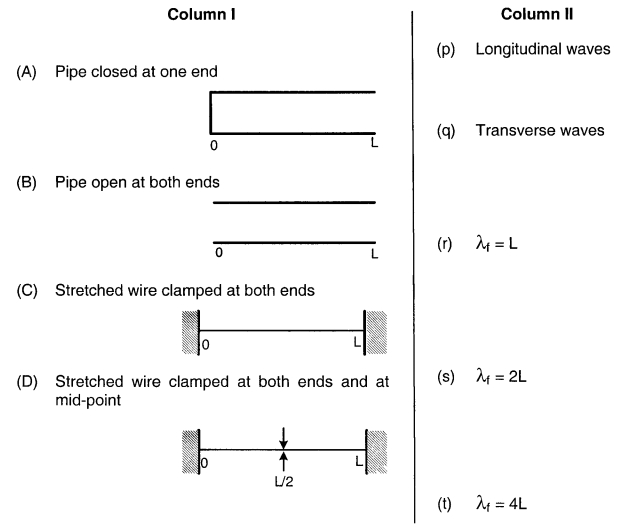
- 10A certain string will resonant to several frequencies, the lowest of which is $200 \,cps$. What are the next three higher frequencies to which it resonants?View Solution