MCQ
The minimum wavelength of X-rays produced by electrons accelerated by a potential difference of volts is equal to
  • A
    $\frac{\mathrm{eV}}{\mathrm{hc}}$
  • B
    $\frac{\mathrm{eh}}{\mathrm{cV}}$
  • $\frac{\mathrm{hc}}{\mathrm{eV}}$
  • D
    $\frac{\mathrm{cV}}{\mathrm{eh}}$

Answer

Correct option: C.
$\frac{\mathrm{hc}}{\mathrm{eV}}$
(c) $\frac{\mathrm{hc}}{\mathrm{eV}}$

Need a full question paper?

Generate a complete, print-ready paper with questions like this in minutes — across 16+ boards, with answer keys.

Start Generating Free

Similar questions

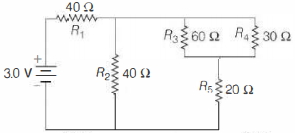
In the circuit shown below, the resistances are given (in $\Omega$ ) and the battery is assumed ideal with emf equal to $3.0 \,V$. The resistor that dissipates the most power is
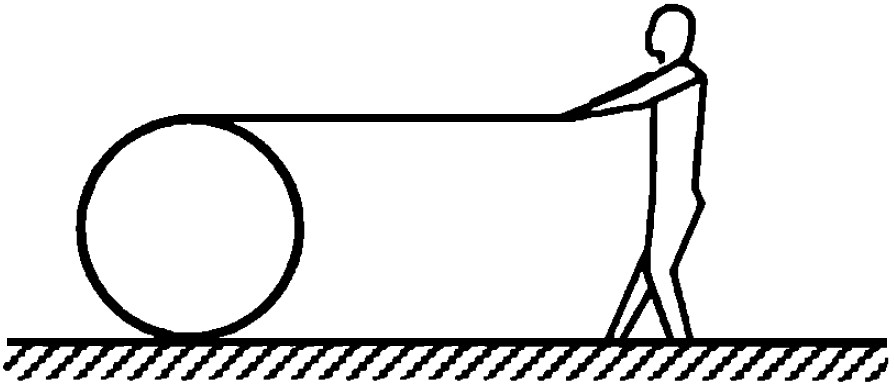
A string of negligible thickness is wrapped several times around a cylinder kept on a rough horizontal surface. A man standing at a distance $1$ from the cylinder holds one end of the string and pulls the cylinder towards him. There is no slipping anywhere. The length of the string passed through the hand of the man while the cylinder reaches his hands is:

The impact of an image on the retina remains for......$sec$
A smaller sphere has potential $50V$ and a larger sphere has potential $100V$. How should they be placed so that if they are connected with the help of a wire, the charge will flow from the smaller sphere to the larger sphere? Both the spheres are conducting and hollow.
Resistance of semiconductor at $0^\circ K$ is
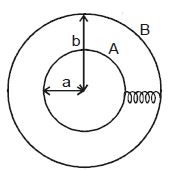
Two spherical conductors $A$ and $B$ of radii $a$ and $b$ $(b > a)$ are placed concentrically in air. The two are connected by a copper wire as shown in figure. Then the equivalent capacitance of the system is
A ray of ligh is incident at an angle of incidence $60^{\circ}$ on the glass slab of refractive index $\sqrt{3}$. After refraction, the light ray emerges out from other parallel faces and lateral shift between incident ray and emergent ray is $4 \sqrt{3} \,cm$. The thickness of the glass slab is. . .  .. . $cm$.
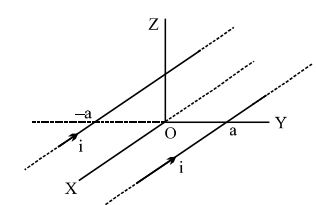
Two long thin, parallel conductors carrying equal currents in the same direction are fixed parallel to the $x$-axis, one passing through $y = a$ and the other through $y = -a$. The resultant magnetic field due to the two conductors at any point is $B$. Which of the following are correct?
Two parallel wires are carrying electric currents of equal magnitude and in the same direction. They exert
The following logic gate is equivalent to