Question
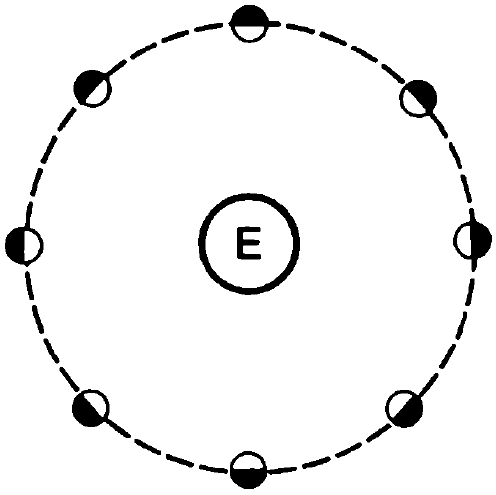
The moon rotates about the earth in such a way that only one hemisphere of the moon faces the earth. Can we ever see the ''other face'' of the moon from the earth? Can a person on the moon ever see all the faces of the earth?
Answer

No, we cannot see the other face of the Moon from the Earth.
Yes, a person on the Moon can see all the faces of the Earth.
Explanation:
Angular velocity of the Moon about its own axis of rotation is same as its angular velocity of revolution about the Earth. This means that its rotation time period equals its revolution time period. So, we can see only one face of the Moon from the Earth.
However, angular velocity of the Earth about its axis is not same as the angular velocity of Moon about the Earth. So, all the faces of the Earth is visible from the Moon.

Need a full question paper?

Generate a complete, print-ready paper with questions like this in minutes — across 16+ boards, with answer keys.
Start Generating Free

Similar questions

A plate current of 10mA is obtained when 60 volts are applied across a diode tube. Assuming the Langmuir-Child equation $\text{i}_\text{p}\propto\text{V}_\text{p}^{\frac{3}{2}}$ to hold, find the dynamic resistance $\text{r}_\text{p}$ in this operating condition.
Read the passage given below and answer the following questions from 1 to 5.Following are properties of vectors
a) Two vectors A and B are said to be equal if, and only if, they have the same magnitude and the same direction.
b) Multiplying a vector A with a positive number λ gives a vector whose magnitude is changed by the factor λ but the direction is the same as that of A:
$|\ \lambda\text{ A }|=\lambda\text{ A }|$
c) The null vector also results when we multiply a vector A by the number zero. Properties of 0 are
A + 0 = A
λ 0 = 0
0 A = 0
d) Subtraction of vectors can be defined in terms of addition of vectors. We define the difference of two vectors A and B as the sum of two vectors A and –B :
A – B = A + (–B).
  1. Two vectors A and B are said to be equal if:
  1. they have the same magnitude
  2. they have the same direction
  3. they have the same magnitude and the same direction
  4. None of these
  1. Multiplying a vector A with a positive number will impact:
  1. Change in magnitude
  2. Change in direction
  3. Change in both magnitude and the same direction
  4. None of these
  1. What is null vector?
  1. How we can perform subtraction of two vectors?
  1. Enlist any 4 properties of vectors.
The plate current, plate voltage and grid voltage of a 6 F 6 triode tube are related as $\mathrm{i}_{\mathrm{p}}=41\left(\mathrm{~V}_{\mathrm{p}}+7 \mathrm{~V}_{\mathrm{g}}\right)^{1.41}$ where $\mathrm{V}_{\mathrm{p}}$ and $\mathrm{V}_{\mathrm{g}}$ are in volts and $\mathrm{i}_{\mathrm{p}}$ in microamperes. The tube is operated at $\mathrm{V}_{\mathrm{p}}=250 \mathrm{~V}, \mathrm{~V}_{\mathrm{g}}=-20 \mathrm{~V}$. Calculate (a) the tube current, (b) the plate resistance, (c) the mutual conductance and (d) the amplification factor.
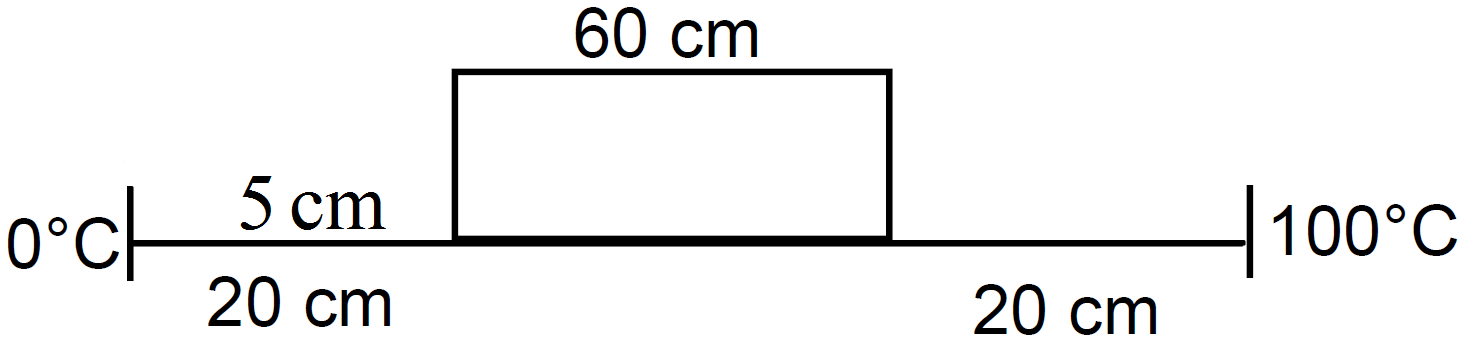
Consider the situation shown in figure. The frame is made of the same material and has a uniform cross-sectional area everywhere. Calculate the amount of heat flowing per second through a cross section of the bent part if the total heat taken out per second from the end at 100°C is 130J.
A person is standing on a weighing machine placed on the floor of an elevator. The elevator starts going up with some acceleration, moves with uniform velocity for a while and finally decelerates to stop. The maximum and the minimum weights recorded are $72kg$ and $60kg$. Assuming that the magnitudes of the acceleration and the deceleration are the same, find:
  1. The true weight of the person.
  2. The magnitude of the acceleration. Take $g = 9.9m/s^2$.
On a winter day, the outside temperature is 0°C and relative humidity 40%. The air from outside comes into a room and is heated to 20°C. What is the relative humidity in the room? The saturation vapour pressure at 0°C is 4.6mm of mercury and at 20°C it is 18mm of mercury.
Read the passage given below and answer the following questions from 1 to 5. The first law refers to the simple case when the net external force on a body is zero. The second law of motion refers to the general situation when there is net external force acting on the body. It relates the net external force to the acceleration of the body. These qualitative observations lead to the second law of motion expressed by Newton as follow: The rate of change of momentum of a body is directly proportional to the applied force and takes place in the direction in which the force acts. Thus, if under the action of a force F for time interval $\triangle\text{t},$ the velocity of a body of mass m changes from v to $\text{v}+\triangle\text{v},$ i.e. its initial momentum p = m v changes by $\triangle\text{p}=\text{m}\triangle\text{v}.$ According to the Second Law $\text{F}\alpha\frac{\triangle\text{p}}{\triangle\text{t}}$ or $\text{F}=\text{k}\frac{\triangle\text{P}}{\triangle\text{t}}$ Where k is a constant of proportionality. Mathematically, F = ma, the unit of force is $kg-m/s^2$ or Newton, which has the symbol N. Let us note at this stage some important points about the second law:
  • In the second law, F = 0 implies a = 0. The second law is obviously consistent with the first law.
  • The second law of motion is a vector law.
  • The second law of motion given by is applicable to a single point particle as well as to the rigid body but internal forces is not considered in F.
  • The second law of motion is a local relation which means that force F at a point in space (location of the particle) at a certain instant of time is related to a at that point at that instant.
  1. SI unit of force is:
  1. Newton
  2. Pascal
  3. m/s
  4. None of the above
  1. According to second law of motion The rate of change of momentum of a body is directly proportional to
  1. Velocity of body
  2. Applied force
  3. Only mass of body
  4. None of the above.
  1. The second law of motion is:
  1. Vector law
  2. Scalar law
  1. State second law of motion.
  1. Write a note on $2^{nd}$ law of motion. Enlist some deductions from $2^{nd} $ law.
The plate resistance and amplification factor of a triode are $10\text{k}\Omega$ and 20. The tube is operated at plate voltage 250V and grid voltage -7.5V. The plate current is 10mA. (a) To what value should the grid voltage be changed so as to increase the plate current to 15mA? (b) To what value should the plate voltage be changed to take the plate current back to 10mA?