Question
The most economical speed to run the train is

Answer

We have, $\frac{d C}{d v}=\frac{375}{4}-\frac{600000}{v^2}$
Put $\frac{d C}{d v}=0 \Rightarrow v^2=\frac{600000 \times 4}{375}=6400$
$\Rightarrow v=80 km / h$
$
\frac{d^2 C}{d v^2}=\frac{2 \times 600000}{v^3}>0 \text {, for } v=80
$
$\therefore$ Most economical speed is $80 km / h$.

Need a full question paper?

Generate a complete, print-ready paper with questions like this in minutes — across 16+ boards, with answer keys.
Start Generating Free

Similar questions

The primitive of the function $\text{f(x)}=\Big(1-\frac{1}{\text{x}^2}\Big)\text{a}^{\text{x}+\frac{1}{\text{x}}},\text{ a}>0$ is:
  1. $\frac{\text{a}^{\text{x}+\frac{1}{\text{x}}}}{\log_\text{e}\text{a}}$
  2. $\log_\text{e}\text{a}\cdot\text{a}^{\text{x}+\frac{1}{\text{x}}}$
  3. $\frac{\text{a}^{\text{x}+\frac{1}{\text{x}}}}{\text{x}}{\log_\text{e}\text{a}}$
  4. $\text{x}\frac{\text{a}^{\text{x}+\frac{1}{\text{x}}}}{\log_\text{e}\text{a}}$
What is the area of the triangle bounded by the lines y = 0, x + y = 0 and x = 4?
  1. 4 units
  2. 8 units
  3. 12 units
  4. 16 units
Direction cosines of the line $\frac{x-1}{2}=\frac{1-y}{3}=\frac{2 z-1}{12}$ are:
Let $R$ be the relation defined on $N \times N$ by the rule $(a, b)\ R\ (c, d) \Leftrightarrow a+d=b+c$, then $R$ is
Let R be a relation on N defined by x + 2y = 8. The domain of R is:
  1. {2, 4, 8}
  2. {2, 4, 6, 8}
  3. {2, 4, 6}
  4. {1, 2, 3, 4}
$\frac{\text{d}}{\text{dx}}\bigg[\log\bigg\{\text{e}^\text{x}\Big(\frac{\text{x}-2}{\text{x}+2}\Big)^\frac{3}{4}\bigg\}\bigg]$ equals:
  1. $\frac{\text{x}^2-1}{\text{x}^2-4}$
  2. $1$
  3. $\frac{\text{x}^2+1}{\text{x}^2-4}$
  4. $\text{e}^\text{x}\frac{\text{x}^2-1}{\text{x}^2-4}$
A fair coin is tossed a fixed number of times. If the probability of getting seven heads is equal to that of getting nine heads, the probability of getting two heads is:
A box contains 3 orange balls, 3 green balls and 2 blue balls. Three balls are drawn at random from the box without replacement. The probability of drawing 22 green balls and one blue ball is
  1. $\frac{167}{168}$
  2. $\frac{1}{28}$
  3. $\frac{2}{21}$
  4. $\frac{3}{28}$
If $y=\left(1+\frac{1}{x}\right)^x$, then $\frac{d y}{d x}=$
Choose the correct answer from the given four options.
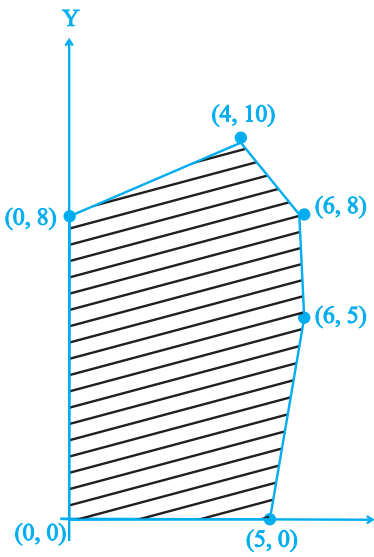
The feasible solution for a LPP is shown in. Let Z = 3x - 4y be the objective function.

Minimum of Z occurs at: