MCQ
The motion of a simple pendulum excuting $S.H.M$. is represented by following equation.

$Y = A \sin (\pi t +\phi)$, where time is measured in $second$.

The length of pendulum is .............$cm$

  • A
    $97.23$
  • B
    $25.3$
  • $99.4$
  • D
    $406.1$

Answer

Correct option: C.
$99.4$
c
$\omega=\sqrt{\frac{ g }{\ell}}=\pi$

$\frac{ g }{\ell}=\pi^{2} \Rightarrow \ell=\frac{ g }{\pi^{2}}$

$\ell=\frac{980}{\pi^{2}} \approx 99.4 \,cm$

Need a full question paper?

Generate a complete, print-ready paper with questions like this in minutes — across 16+ boards, with answer keys.

Start Generating Free

Similar questions

The air density at Mount Everest is less than that at the sea level. It is found by mountaineers that for one trip lasting a few hours, the extra oxygen needed by them corresponds to $30,000\, cc$ at sea level (pressure $1$ atmosphere, temperature $27°C$). Assuming that the temperature around Mount Everest is $-73°C$ and that the oxygen cylinder has capacity of $5.2 \,litre,$ the pressure at which ${O_2}$ be filled (at site) in cylinder is  .... $atm$
If earth suddenly stop rotating, then the weight of an object of mass $m$ at equator will $[\omega$ is angular speed of earth and $R$ is its radius]
Temperature of a black body increases from ${327^o}C\,{\rm{to}}\,{\rm{92}}{{\rm{7}}^{\rm{o}}}C$, the initial energy possessed is $ 2KJ$ , what is its final energy ..... $KJ$
The equation $\left( {P + \frac{a}{{{V^2}}}} \right)$ $(V - b)$ constant. The units of $a$ are
The time period of a satellite is related to the density of earth $(\rho)$ as:
A block of mass $m$ slides on the wooden wedge, which in turn slides backward on the horizontal surface. The acceleration of the block with respect to the wedge is : Given ${m}=8 \,{kg}, {M}=16\, {kg}$

Assume all the surfaces shown in the figure to be frictionless.
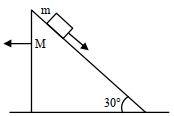
A particle moves in the $xy$ plane with a constant acceleration $'g'$ in the negative $y$-direction. Its equation of motion is $y = ax-bx^2$, where $a$ and $b$ are constants. Which of the following are correct?
A projectile is thrown at an angle $\theta$ with the horizontal and its range is $R_1$. It is then thrown at an angle $\theta$ with vertical and the range is $R_2$, then
A person travelling on a straight line moves with a uniform velocity $v_1$ for a distance $x$ and with a uniform velocity $v-2$ for the next equal distance. The average velocity $v$ is given by:
The root mean square speed of smoke particles of mass $5 \times 10^{-17}\,kg$ in their Brownian motion in air at NTP is approximately $.......\,mm\,s ^{-1}$ [Given $k =1.38 \times 10^{-23}\,J\,K ^{-1}$ ]