MCQ
The motion of a swing is:
  • A
    Periodic but not oscillatory.
  • B
    Oscillatory.
  • C
    Linear simple harmonic.
  • D
    Circular motion.

Answer

  1. Oscillatory.

Need a full question paper?

Generate a complete, print-ready paper with questions like this in minutes — across 16+ boards, with answer keys.

Start Generating Free

Similar questions

An artificial earth satellite of mass m is circling round the earth in an orbit of radius R. If the mass of the earth is M, then the total energy of the satellite is:
The velocity of efflux of a liquid through an orifice in the bottom of the tank does not depend upon
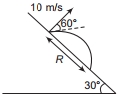
A projectile is launched with a speed of $10\,m / s$ at an angle $60^{\circ}$ with the horizontal from a sloping surface of inclination $30^{\circ}$. The range $R$ is $........\,m$ (Take $g=10\,m / s ^2$ )
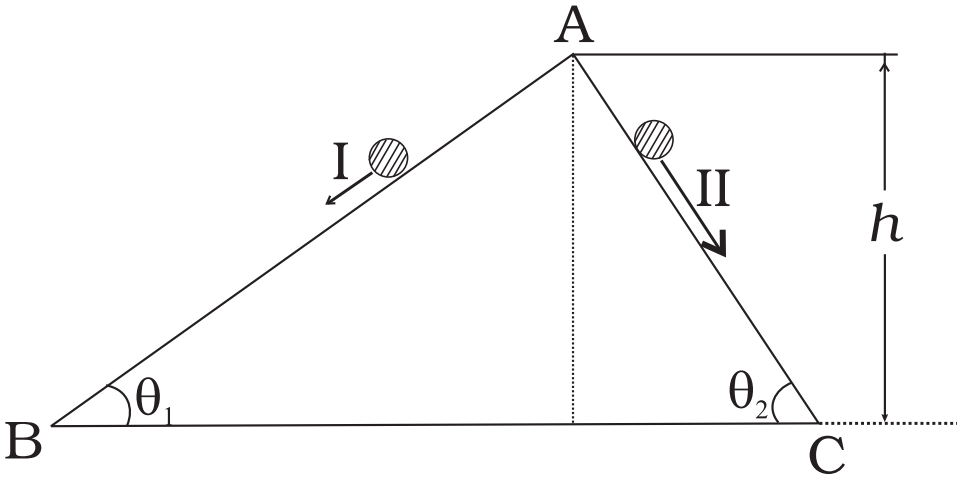
Two inclined frictionless tracks, one gradual and the other steep meet at A from where two stones are allowed to slide down from rest, one on each track as shown in which of the following statement is correct?
A frictionless heat engine can be $100 \%$ efficient only if its exhaust temperature is ............
$1$ mole of gas occupies a volume of $100\, ml$ at $50\, mm$ pressure. What is the volume occupied by two moles of gas at $100\, mm$ pressure and at same temperature ..... $ml$
A particle of mass $m$ slides from rest down a plane inclined at $30^o$ to the horizontal. The force of resistance acting on the particle during motion is $ms^2$ where $s$ is the displacement of the particle from its initial position. The velocity (in $m/s$) of the particle when $s = 1\,m$ is $v$. The value of $\frac{3v^2}{14}$ is :-
Water falls from a height of $60\, m$ at the rate of $15 kg/s$ to operate a turbine. The losses due to frictional forces are $10\%$ of energy. How much power is generated by the turbine ............. $\mathrm{kW}$ ? $\, (g = 10 \,m/s^2)$
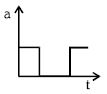
The acceleration-time graph for a body is shown in the graph. Which of the following  graphs would probably represent velocity of the body plotted against time:-
What is the torque of the force $\mathop F\limits^ \to   = (2\hat i - 3\hat j + 4\hat k)N$ acting at the pt. $\mathop r\limits^ \to   = (3\hat i + 2\hat j + 3\hat k)\,m$ about the origin