The net resistance of a voltmeter should be large to ensure that
Easy
Download our app for free and get started
(d) The resistance of voltmeter is too high, so that it draws negligible current from the circuit, hence potential drop in the external circuit is also negligible.

Download our appand get started for free
Experience the future of education. Simply download our apps or reach out to us for more information. Let's shape the future of learning together!No signup needed.*
Similar Questions
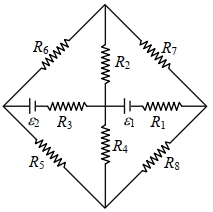
- 1The figure shows a circuit having eight resistances of $1 \Omega$ each, labelled $R_1$ to $R_8$, and two ideal batteries with voltages $\varepsilon_1=12 V$ and $\varepsilon_2=6 V$.View Solution
Which of the following statement($s$) is(are) correct?
$(A)$ The magnitude of current flowing through $R_1$ is $7.2 A$.
$(B)$ The magnitude of current flowing through $R_2$ is $1.2 A$.
$(C)$ The magnitude of current flowing through $R_3$ is $4.8 A$.
$(D)$ The magnitude of current flowing through $R_5$ is $2.4 A$.
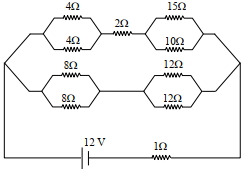
- 2The voltage drop across $15\, \Omega$ resistance in the given figure will be $.....V.$View Solution
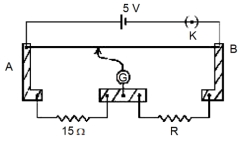
- 3A meter bridge setup is shown in the figure. It is used to determine an unknown resistance $R$ using a given resistor of $15\,\Omega$. The galvanometer $(G)$ shows null deflection when tapping key is at $43\,cm$ mark from end $A$. If the end correction for end $A$ is $2\,cm$. then the determined value of $R$ will be__________ $\Omega$View Solution
- 4Calculate the amount of charge flowing in $2$ minutes in a wire of resistance $10$ $\Omega$ when a potential difference of $20\,V$ is applied between its ends ............ $C$View Solution
- 5Two bulbs are working in parallel order. Bulb $A$ is brighter than bulb $B$. If ${R_A}$ and ${R_B}$ are their resistance respectively thenView Solution
- 6$A$. The drift velocity of electrons decreases with the increase in the temperature of conductor.View Solution
$B$. The drift velocity is inversely proportional to the area of cross-section of given conductor.
$C$. The drift velocity does not depend on the applied potential difference to the conductor.
$D$. The drift velocity of electron is inversely proportional to the length of the conductor.
$E$. The drift velocity increases with the increase in the temperature of conductor.
Choose the correct answer from the options given below:
- 7The e.m.f. of a cell is $E\, volts$ and internal resistance is $r$ $ohm$. The resistance in external circuit is also $r$ $ohm$. The p.d. across the cell will beView Solution
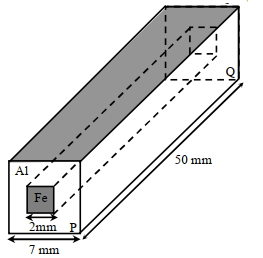
- 8In an aluminium $(A1)$ bar of square cross section, a square hole is drilled and is filled with iron ( $Fe$ ) as shown in the figure. The electrical resistivities of $A 1$ and $Fe$ are $2.7 \times 10^{-8} \ \Omega m$ and $1.0 \times 10^{-7} \ \Omega m$, respectively. The electrical resistance between the two faces $P$ and $Q$ of the composite bar isView Solution
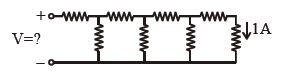
- 9Each element in the finite chain of resistors shown in the figure is $\,1\,\Omega $ . A current of $1\, A$ flows through the final element. Then what is the potential difference $V$ across input terminals of the chain .................. $\mathrm{volt}$View Solution
- 10A battery consists of a variable number $n$ of identical cells (having internal resistance reach) which are connected in series. The terminals of the battery are short-circuited and the current $I$ is measured. Which of the graphs shows the correct relationship between $I$ and $n \,?$View Solution