MCQ
The normal at a variable point $P$ on an ellipse $\frac{{{x^2}}}{{{a^2}}} + \frac{{{y^2}}}{{{b^2}}}= 1$  of eccentricity e meets the axes of the ellipse in $ Q$  and $R$  then the locus of the mid-point of $QR$  is a conic with an eccentricity $e' $  such that :
  • A
    $e'$ is independent of  $e$
  • B
    $e ' = 1$
  • $e' = e$
  • D
    $e' = 1/e$

Answer

Correct option: C.
$e' = e$
c
Normal at point $P(a \cos \theta, b \sin \theta)$ is

$\frac{a x}{\cos \theta}-\frac{b y}{\sin \theta}=a^{2}-b^{2}$

It meets axes at $Q\left(\frac{\left(a^{2}-b^{2}\right) \cos \theta}{a}, 0\right)$

and $R\left(0,-\frac{\left(a^{2}-b^{2}\right) \sin \theta}{b}\right)$

Let $T(h, k)$ is a midpoint of $Q R$ Then $2 h=\frac{\left(a^{2}-b^{2}\right) \cos \theta}{a}$

and $2 k=-\frac{\left(a^{2}-b^{2}\right) \sin \theta}{b}$

$\Rightarrow \cos ^{2} \theta+\sin ^{2} \theta=\frac{4 h^{2} a^{2}}{\left(a^{2}-b^{2}\right)^{2}}+\frac{4 k^{2} b^{2}}{\left(a^{2}-b^{2}\right)^{2}}=1$

$\Rightarrow$ Locus is $\frac{x^{2}}{\frac{\left(a^{2}-b^{2}\right)^{2}}{4 a^{2}}}+\frac{y^{2}}{\frac{\left(a^{2}-b^{2}\right)^{2}}{4 b^{2}}}=1$

which is an ellipse, having eccentricity $e^{\prime},$ given by $e^{r 2}=1-\frac{\frac{\left(a^{2}-b^{2}\right)^{2}}{4 a^{2}}}{\frac{\left(a^{2}-b^{2}\right)^{2}}{4 b^{2}}}=1-\frac{b^{2}}{a^{2}}=e^{2}$

$e^{\prime}=e$

Note : In Equation (ii), $\frac{\left(a^{2}-b^{2}\right)}{4 a^{2}}<\frac{\left(a^{2}-b^{2}\right)}{4 b^{2}}$. Hence, $x$ -axis is minor axis.

Need a full question paper?

Generate a complete, print-ready paper with questions like this in minutes — across 16+ boards, with answer keys.

Start Generating Free

Similar questions

${\mathop{\rm Re}\nolimits} \frac{{{{(1 + i)}^2}}}{{3 - i}}$ =
If $A$ and $B$ are two fixed points and $P$ is a variable point such that $PA + PB = 4$, then the locus of $P$ is a/an
The vertex of a parabola is the point $(a, b)$ and latus rectum is of length $l$. If the axis of the parabola is along the positive direction of $y$ - axis, then its equation is
In the expansion of ${(1 + x)^{50}},$ the sum of the coefficient of odd powers of $x$ is
What is the probability that when one die is thrown, the number appearing on top is even
Answer the following by appropriately matching the lists based on the information given in the paragraph

Let the circles $C_1: x^2+y^2=9$ and $C_2:(x-3)^2+(y-4)^2=16$, intersect at the points $X$ and $Y$. Suppose that another circle $C_3:(x-h)^2+(y-k)^2=r^2$ satisfies the following conditions :

$(i)$ centre of $C _3$ is collinear with the centres of $C _1$ and $C _2$

$(ii)$ $C _1$ and $C _2$ both lie inside $C _3$, and

$(iii)$ $C _3$ touches $C _1$ at $M$ and $C _2$ at $N$.

Let the line through $X$ and $Y$ intersect $C _3$ at $Z$ and $W$, and let a common tangent of $C _1$ and $C _3$ be a tangent to the parabola $x^2=8 \alpha y$.

There are some expression given in the $List-I$ whose values are given in $List-II$ below:

$List-I$ $List-II$
$(I)$ $2 h + k$ $(P)$ $6$
$(II)$ $\frac{\text { Length of } ZW }{\text { Length of } XY }$ $(Q)$ $\sqrt{6}$
$(III)$ $\frac{\text { Area of triangle } MZN }{\text { Area of triangle ZMW }}$ $(R)$ $\frac{5}{4}$
$(IV)$ $\alpha$ $(S)$ $\frac{21}{5}$
  $(T)$ $2 \sqrt{6}$
  $(U)$ $\frac{10}{3}$

($1$) Which of the following is the only INCORRECT combination?

$(1) (IV), (S)$ $(2) (IV), (U)$ $(3) (III), (R)$ $(4) (I), (P)$

($2$) Which of the following is the only CORRECT combination?

$(1) (II), (T)$ $(2) (I), (S)$ $(3) (I), (U)$ $(4) (II), (Q)$

Give the answer or quetion ($1$) and ($2$)
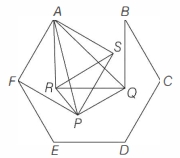
The probability of happening an event $A$ in one trial is $0.4$. The probability that the event $A$ happens at least once in three independent trials is
If $\alpha,-\frac{\pi}{2}<\alpha<\frac{\pi}{2}$ is the solution of $4 \cos \theta+5 \sin \theta=1$, then the value of $\tan \alpha$ is
If sum of infinite terms of a $G.P.$ is $3$ and sum of squares of its terms is $3$, then its first term and common ratio are
In the figure given below, $A B C D E F$ is a regular hexagon of side length $1$, $A F P S$ and $A B Q R$ are squares. Then, the ratio $\operatorname{ar}(A P Q) \operatorname{lar}(S R P)$ equals