MCQ
The object is released from rest under gravity at $y = 0$. The equation of motion which correctly expresses the above situation is:
  • A
    $\text{v} = -9.8\text{t ms}^{-1}$
  • B
    $\text{v} = (9.8 - 9.8\text{t)m/s}$
  • $\text{v}^2 = -19.6\text{y}^2 \text{m}^2\text{s}^{-2}$
  • D
    $\text{v}^2=(\text{v}^2_0+29.6\text{y})\text{m}^2/\text{s}^2$
Answer

Correct option: C.
$\text{v}^2 = -19.6\text{y}^2 \text{m}^2\text{s}^{-2}$
For free fall, $v_0 = 0, a = -g = -9.8\ ms^{-1}$
The equations of motion are
$v = -9.8t\ ms^{-1} ($using $v = v_0 + at)$
$v^2 = 2(-9.8)y ($using $\text{v}^2=\text{v}^2_0+2\text{ay})$
$= -19.6y\ m^2s^{-2}$

Need a full question paper?

Generate a complete, print-ready paper with questions like this in minutes — across 16+ boards, with answer keys.

Start Generating Free

Similar questions

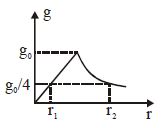
Figure shows variation of acceleration due to gravity with distance from centre of a  uniform spherical planet, Radius of planet is $R$. What is $r_2 -r_1.$
A $60 \,kg$ weight is dragged on a horizontal surface by a rope upto $ 2$ metres. If coefficient of friction is $\mu = 0.5$, the angle of rope with the surface is $60^°$ and $g = 9.8\,m/{\sec ^2}$, then work done is ........ $joules$
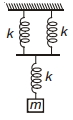
A block of mass $m$ hangs from three springs having same spring constant $k$. If the mass is slightly displaced downwards, the time period of oscillation will be
The quantities $A$ and $B$ are related by the relation, $m = A/B$, where $m$ is the linear density and $A$ is the force. The dimensions of $B$ are of
A particle starts from origin at $t=0$ with a velocity $5 \hat{i} \mathrm{~m} / \mathrm{s}$ and moves in $x-y$ plane under action of a force which produces a constant acceleration of $(3 \hat{i}+2 \hat{j}) \mathrm{m} / \mathrm{s}^2$. If the $x$-coordinate of the particle at that instant is $84 \mathrm{~m}$, then the speed of the particle at this time is $\sqrt{\alpha} \mathrm{m} / \mathrm{s}$. The value of $\alpha$ is___________.
A liquid boils when its vapour pressure is equal to
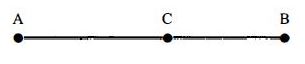
$A$ and $B$ are two sources generating sound waves. A listener is situated at $C$ . The frequency of the source at $A$ is $500\,Hz$ . $A,$ now, moves towards $C$ with a speed $4\,m/s.$ The number of beats heard at $C$ is $6.$ When $A$ moves away from $C$ with speed $4\,m/s,$ the number of beats heard at $C$ is $18.$ The speed of sound is $340\,m/s.$ The frequency of the source at $B$ is ..... $Hz$
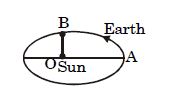
The earth moves around the Sun in an elliptical orbit as shown in figure.The ratio $OA/OB = x$ . The ratio of the speed of the earth at $B$ to that at $A$ is nearly
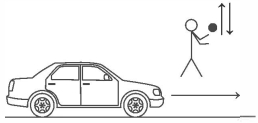
A boy standing on the footpath tosses a ball straight up and catches it. The driver of a car passing by moving with uniform velocity sees this.The trajectory of the ball as seen by the driver will be
A point mass of $1 \mathrm{~kg}$ collides elastically with a stationary point mass of $5 \mathrm{~kg}$. After their collision, the $1 \mathrm{~kg}$ mass reverses its direction and moves with a speed of $2 \mathrm{~ms}^{-1}$. Which of the following statement(s) is (are) correct for the system of these two masses?

$(A)$ Total momentum of the system is $3 \mathrm{~kg} \mathrm{~ms}^{-1}$

$(B)$ Momentum of $5 \mathrm{~kg}$ mass after collision is $4 \mathrm{~kg} \mathrm{~ms}^{-1}$

$(C)$ Kinetic energy of the centre of mass is $0.75 \mathrm{~J}$

$(D)$ Total kinetic energy of the system is $4 \mathrm{~J}$