MCQ
The order of relative reactivity of the given halides towards $S_N1$ reaction is
  • A
    benzylchloride $> p-$ methoxybenzylchloride $> p-$ nitrobenzylchloride
  • $p-$ methoxybenzylchloride $ > $ benzylchloride $ >  p-$ nitrobenzylchloride
  • C
    $p-$ methoxybenzylchloride $ > p-$ nitrobenzylchloride $ > $ benzylchloride
  • D
    benzylchloride $ > p-$ nitrobenzylchloride $ > p-$ methoxybenzylchloride
Answer

Correct option: B.
$p-$ methoxybenzylchloride $ > $ benzylchloride $ >  p-$ nitrobenzylchloride
b

Need a full question paper?

Generate a complete, print-ready paper with questions like this in minutes — across 16+ boards, with answer keys.

Start Generating Free

Similar questions

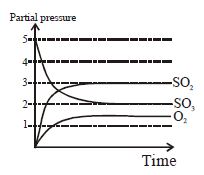
The dissociation of $SO_3(g)$ into $SO_2(g)$ & $O_2(g)$ is carried out in a closed container at a constant temperature $T$ . The equilibrium constant for the reaction is $K_P$ = $x\  atm^2$ . The partial pressure variation for the three gases is as shown 

The value of $x$ is

Which is the $CORRECT$ relation of bond angles?
But $-1-$ yne and But $-2-$ yne can be distinguished by
At temperature $T$ a compound $AB_2(g)$ dissociates according to the reaction with a degree of dissociation $'x'$ which is very small compared to unity. The value of $x$ is 

$2A{B_2}(g) \rightleftharpoons 2AB(g) + {B_2}(g)$

For the reaction $A ( g ) \rightleftharpoons B ( g )$ at $495\, K$

$\Delta_{ I } G ^{\circ}=-9.478\, kJ\, mol ^{-1}$

If we start the reaction in a closed container at $495\, K$ with $22$ millimoles of $A ,$ the amount of $B$ is the equilibrium mixture is millimoles ..............

(Round off to the Nearest Integer).

$\left[ R =8.314 J mol ^{-1} K ^{-1} ; \ell n 10=2.303\right]$

In which of the following compounds, is the oxidation number of sulphur is the least?
Which of the following alkene on catalytic hydrogenation given cis and trans- isomer?
The equilibrium $\ce{2SO_2​(g) + O_2(g) ⇌ 2SO_3​(g)}$ shifts forward if:
$Pi$ bond is formed:
The electronic configuration of four elements $L, P, Q$ and $R$ are given the brackets

$L(1s^2, 2s^2 2p^4); Q(1s^2, 2s^2 2p^6, 3s^2 3p^5)$
$P(1s^2, 2s^2 2p^6, 3s^1); R(1s^2, 2s^2 2p^6, 3s^2)$

The formulae of ionic compounds that can be formed between these elements are