MCQ
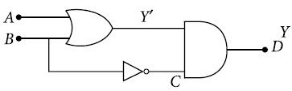
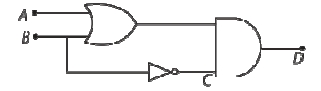
The output for the given, circuit is
  • $( A + B ) \cdot \overline{ B }$
  • B
    $( A \cdot B ) \cdot \overline{ B }$
  • C
    $( A + B ) \cdot B$
  • D
    $( A \cdot B ) \cdot B$

Answer

Correct option: A.
$( A + B ) \cdot \overline{ B }$
a
$(a)$ Here $Y^{\prime}=A+B$ and $Y=Y^{\prime} \cdot \bar{B}=(A+B) \cdot B$


Need a full question paper?

Generate a complete, print-ready paper with questions like this in minutes — across 16+ boards, with answer keys.

Start Generating Free

Similar questions

There are three resistance coils of equal resistance. The maximum number of resistances you can obtain by connecting them in any manner you choose, being free to use any number of the coils in any way is
Assertion : Diamagnetic materials can exhibit magnetism.

Reason : Diamagnetic materials have permanent magnetic dipole moment.
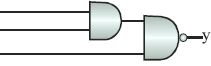
The output $y$, when all three inputs are first high and then low, will respectively be
Let $\mathrm{i}_{\mathrm{E}}$, $\mathrm{i}_{\mathrm{C}}$ and $\mathrm{i}_{\mathrm{B}}$ represent the emitter current, the collector current and the base current respectively in a transistor. Then,
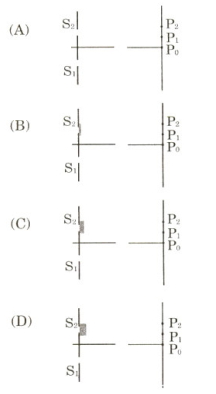
Column $I$ shows four situations of standard Young's double slit arrangement with the screen placed far away from the slits $S_1$ and $S_2$. In each of these cases $\mathrm{S}_1 \mathrm{P}_0=\mathrm{S}_2 \mathrm{P}_0, \mathrm{~S}_1 \mathrm{P}_1-\mathrm{S}_2 \mathrm{P}_1=\lambda / 4$ and $\mathrm{S}_1 \mathrm{P}_2-\mathrm{S}_2 \mathrm{P}_2=\lambda / 3$, where $\lambda$ is the wavelength of the light used. In the cases $\mathrm{B}, \mathrm{C}$ and $\mathrm{D}$, a transparent sheet of refractive index $\mu$ and thickness $t$ is pasted on slit $\mathrm{S}_2$. The thicknesses of the sheets are different in different cases. The phase difference between the light waves reaching a point $\mathrm{P}$ on the screen from the two slits is denoted by $\delta(\mathrm{P})$ and the intensity by $I(\mathrm{P})$. Match each situation given in Column $I$ with the statement$(s)$ in Column $II$ valid for that situation.

Column $I$ Column $II$
$(A)$ $Image$ $(p)$ $\delta\left(\mathrm{P}_0\right)=0$
$(B)$ $(\mu-1) t=\lambda / 4$ $Image$ $(q)$ $\delta\left(\mathrm{P}_1\right)=0$

$(C)$ $(\mu-1) t=\lambda / 2$ $Image$

$(r)$ $I\left(\mathrm{P}_1\right)=0$
$(D)$ $(\mu-1) t=3 \lambda / 4$ $Image$ $(s)$ $\left(\mathrm{P}_0\right)>I\left(\mathrm{P}_1\right)$
  $(t)$ $I\left(\mathrm{P}_2\right)>I\left(\mathrm{P}_1\right)$

Which of the following would you prefer to use while reading small letters found in a dictionary?
A convex lens forms a real image of an object for its two different positions on a screen. If height of the image in both the cases be 8 cm and 2 cm, then height of the object is
 
In an optics experiment, with the position of the object fixed, a student varies the position of a convex lens and for each position, the screen is adjusted to get a clear image of the object. A graph between the object distance $u$ and the image distance $v$, from the lens, is plotted using the same scale for the two axes. A straight line passing through the origin and making an angle of $45 ^o $ with the $x-$axis meets the experimental curve at $P$. The coordinates of $P$ will be
Let $n_r$ and $n_b$ be respectively the number of photons emitted by a red bulb and a blue bulb of equal power in a given time.
A convex lens A of focal length 20 cm and a concave lens B of focal length 5 cm are kept along the same axis with the distance d between them. If a parallel beam of light falling on A leaves B as a parallel beam, then distance d in cm will be