MCQ
Assertion : Diamagnetic materials can exhibit magnetism.

Reason : Diamagnetic materials have permanent magnetic dipole moment.

  • A
    If both Assertion and Reason are correct and the Reason is a correct explanation of the Assertion.
  • B
    If both Assertion and Reason are correct but Reason is not a correct explanation of the Assertion.
  • If the Assertion is correct but Reason is incorrect.
  • D
    If both the Assertion and Reason are incorrect.
Answer

Correct option: C.
If the Assertion is correct but Reason is incorrect.
c
Diamagnetic material exhibits magnetism in reverse direction. $R$ is a wrong statement. Because due to absence of unpaired electron in diamagnetic material it does not exhibit permanent magnet dipole moment.

Need a full question paper?

Generate a complete, print-ready paper with questions like this in minutes — across 16+ boards, with answer keys.

Start Generating Free

Similar questions

When the atomic number $A$ of the nucleus increases
In a potentiometer arrangement, a cell gives a balancing point at $75\, cm$ length of wire. This cell is now replaced by another cell of unknown emf. If the ratio of the emf's of two cells respectively is $3: 2$, the difference in the balancing length of the potentiometer wire in above two cases will be.........$cm .$
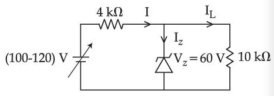
In the circuit shown below, maximum zener diode current will be $.....mA$
In a $PN-$ junction diode not connected to any circuit
Identify the type of materials which develop electric currents in them, when an electric field is applied.
Two electric bulbs whose resistances are in the ratio of 1 : 2 are connected in series. The powers dissipated in them have the ratio
If a diamagnetic solution is poured into a U-tube and one arm of this U-tube placed between the poles of a strong magnet with the meniscus in a line with the field, then the level of the solution will
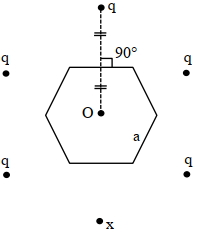
Six charges are placed around a regular hexagon of side length a as shown in the figure. Five of them have charge $q$, and the remaining one has charge $x$. The perpendicular from each charge to the nearest hexagon side passes through the center $O$ of the hexagon and is bisected by the side.

Which of the following statement($s$) is(are) correct in SI units?

$(A)$ When $x=q$, the magnitude of the electric field at $O$ is zero.

$(B)$ When $x=-q$, the magnitude of the electric field at $O$ is $\frac{q}{6 \pi \in_0 a^2}$.

$(C)$ When $x=2 q$, the potential at $O$ is $\frac{7 q}{4 \sqrt{3} \pi \in_0 a}$.

$(D)$ When $x=-3 q$, the potential at $O$ is $\frac{3 q}{4 \sqrt{3} \pi \in_0 a}$.

Half life period of a radioactive sample is $T$. Let $x$ fraction disintegrates in time $'t'$. How much fraction will decay in $'\frac{t}{2}'$ time
An inductance of $2\,H$ carries a current of $2\,A$. To prevent sparking when the circuit is broken a capacitor of $4\,\mu F$ is connected across the inductance. The voltage rating of the capacitor is of the order of