MCQ
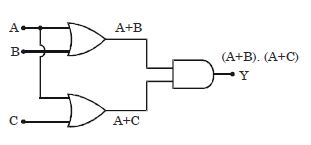
The output of given logic circuit is
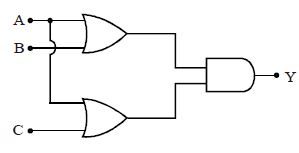
  • A
    $A \cdot \left( {B + C} \right)$
  • B
    $A \cdot \left( {B \cdot C} \right)$
  • $\left( {A + B} \right) \cdot (A + C)$
  • D
    $A + B + C$

Answer

Correct option: C.
$\left( {A + B} \right) \cdot (A + C)$
c

Need a full question paper?

Generate a complete, print-ready paper with questions like this in minutes — across 16+ boards, with answer keys.
Start Generating Free

Similar questions

An $AC$ current is given by $I = I_0 + I_1$ $sin\, wt$ then its $rms$ value will be
$CO_2$ gas is found in which of the following pairs of the planet
Two different coils have inductances $L_1 = 4\ mH$ and $L_2 = 2\ mH$ . At a certain instant the current in the two coils is increasing at the same constant rate and power supplied to the first coil is four time that of in second coil. If $e$ , $I$ and $U$ indicate the potential difference, current and energy stored of the inductance respectively than which of the following is correct
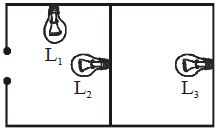
Figure shows three similar lamps $L_1, L_2$ and $L_3$ connected across a power supply. If the lamp $L_3$ fuses, how will the light emitted by $L_1$ and $L_2$ change ?
The pressure that has to be applied to the ends of a steel wire of length $10\ cm$ to keep its length constant when its temperature is raised by $100^o C$ is: (For steel Young's modulus is $2 \times 10^{11}$ $Nm^{-1}$ and coefficient of thermal expansion is $1.1 \times 10^{-5}$ $K^{-1}$ )
On the superposition of two harmonic oscillations represented by ${x_1} = a\,\sin \,\left( {\omega t + {\phi _1}} \right)$ and ${x_2} = a\,\sin \,\left( {\omega t + {\phi _2}} \right)$ a resulting oscillation with the same time period and amplitude is obtained. The value of ${\phi _1} - {\phi _2}$ is .... $^o$
In $n_e$ and $v_d$ be the number of electrons and drift velocity in a semiconductor. When the temperature is increased
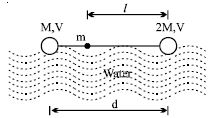
A dumbbell is placed in water of density $\rho$ . It is observed that by attaching a mass $m$ to the rod, the dumbbell floats with the rod horizontal on the surface of water and each sphere exactly half submerged as shown in the figure. The volume of the mass $m$ is negligible. The value of length $l$ is
A sphere of relative density $\sigma$ and diameter $D$ has concentric cavity of diameter $d$. The ratio of $\frac{D}{d}$, if it just floats on water in a tank is:
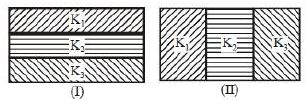
Two identical parallel plate capacitors, of capacitance $C$ each, have plates of area $A$, separated by a distance $d$. The space between the plates of the two capacitors, is filled with three dielectrics, of equal thickness and dielectric constants $K_1$ , $K_2$ and $K_3$ . The first capacitor is filled as shown in fig. $I$, and the second one is filled as shown in fig. $II$. If these two modified capacitors are charged by the same potential $V$, the ratio of the energy stored in the two, would be ( $E_1$ refers to capacitor $(I)$ and $E_2$ to capacitor $(II)$)