Question
The path difference between two interfering waves of equal intensities at a point on the screen is $\frac{\lambda }{4}.$ The ratio of intensity at this point and that at the central fringe will be

Answer

(b) By using $I = 4{I_0}{\cos ^2}\left( {\frac{\phi }{2}} \right) = 4{I_0}{\cos ^2}\left( {\frac{{\pi \Delta }}{\lambda }} \right)$

                                                  $\left\{ {\because  \phi  = \frac{{2\pi }}{\lambda }\Delta } \right\}$

==> $\frac{{{I_1}}}{{{I_2}}} = \frac{{{{\cos }^2}\left( {\frac{{\pi {\Delta _1}}}{\lambda }} \right)}}{{{{\cos }^2}\left( {\frac{{\pi {\Delta _2}}}{\lambda }} \right)}} = \frac{{{{\cos }^2}\left( {\frac{{\pi .\frac{\lambda }{4}}}{\lambda }} \right)}}{{{{\cos }^2}(0)}} = \frac{1}{2}$

Need a full question paper?

Generate a complete, print-ready paper with questions like this in minutes — across 16+ boards, with answer keys.

Start Generating Free

Similar questions

A sample contains mixture of helium and oxygen gas. The ratio of root mean square speed of helium and oxygen in the sample, is:
Which statement about the Rutherford model of the atom is not true?
$\begin{matrix}
   O\,\,\,\,\,\,\,\,\,\,\,\,\,\,\,\,\,\,\,\,\,\,\,\,\,\,\,\,\,\,\,\,\,\,\,\,\,\,\,\,\,\,\,\,\,\,\,\,\,\,\,\,\,\,\,\,\,\,\,\,\,\,\,\,\,\,\,\,\,\,\,  \\
   ||\,\,\,\,\,\,\,\,\,\,\,\,\,\,\,\,\,\,\,\,\,\,\,\,\,\,\,\,\,\,\,\,\,\,\,\,\,\,\,\,\,\,\,\,\,\,\,\,\,\,\,\,\,\,\,\,\,\,\,\,\,\,\,\,\,\,\,\,\,\,\,\,  \\
   P{{h}_{2}}CH-C-H\xrightarrow{aqueous\,acid}\underset{81\%}{\mathop{(A)}}\,+\underset{2\%}{\mathop{enol}}\,+\underset{17\%}{\mathop{aldehyde}}\,  \\
\end{matrix}$

Product $(A)$ of above reaction will be
Spherical balls of radius $ 'r'$  are falling in a viscous fluid of viscosity '$\eta$' with a velocity $ 'v'. $ The retarding viscous force acting on the spherical ball is
A thin infinite sheet charge and an infinite line charge of respective charge densities $+\sigma$ and $+\lambda$ are placed parallel at $5\,m$ distance from each other. Points $P$ and $Q$, are at $\frac{3}{\pi} m$ and $\frac{4}{\pi} m$ perpendicular distance from line charge towards sheet charge, respectively. $E_P$ and $E_Q$ are the magnitudes of resultant electric field intensities at point $P$ and $Q$, respectively. If $\frac{E_p}{E_Q}=\frac{4}{a}$ for $2|\sigma|=|\lambda|$. Then the value of $a$ is ...........
An object is placed in front of a spherical mirror whose $2\, times$ magnified image is formed on screen. Then choose $CORRECT$ option
Two charged conducting spheres of radii $a$ and $b$ are connected to each other by a conducting wire. The ratio of charges of the two spheres respectively is:
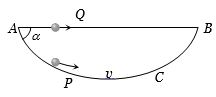
A particle $P$ is sliding down a frictionless hemispherical bowl. It passes the point $A$ at $t = 0$. At this instant of time, the horizontal component of its velocity is $v$. A bead $Q$ of the same mass as $P$ is ejected from $A$ at $t = 0$ along the horizontal string $AB$ (see figure) with the speed $v$. Friction between the bead and the string may be neglected. Let ${t_P}$ and ${t_Q}$ be the respective time taken by $P$ and $Q$ to reach the point $B$. Then
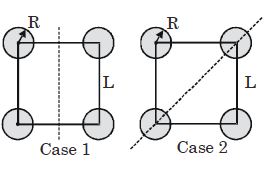
Four hollow spheres, each with a mass of $1\, kg$ and a radius $R = 10\,cm$, are connected with massless rods to form a square with side of length $L = 50\, cm$, In case $-1$, the masses rotate about an axis that bisects two sides of the square. In case $-2$, the masses rotate about an axis that passes through the diagonal of the square, as shown in the figure. Compute the ratio of the moments of inertia $I_1/I_2$, for the two cases
A body falling on the ground from $a$ height of $10\, m$, rebounds to a height $2.5\, m,$ then the ratio of the velocities of the body just before and after the collision will be