MCQ
The period of a simple pendulum is doubled, when
  • A
    Its length is doubled
  • B
    The mass of the bob is doubled
  • Its length is made four times
  • D
    The mass of the bob and the length of the pendulum are doubled

Answer

Correct option: C.
Its length is made four times
c
(c) $T = 2\pi \sqrt {\frac{l}{g}} $

==> $T \propto \sqrt l $

Need a full question paper?

Generate a complete, print-ready paper with questions like this in minutes — across 16+ boards, with answer keys.
Start Generating Free

Similar questions

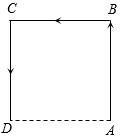
A particle moves along the sides $AB, BC, CD$ of a square of side $25 \,m$ with a velocity of $15$$m{s^{ - 1}}.$ Its average velocity is........$m{s^{ - 1}}$
A boy is swinging in a swing. If he stands the time period will
A body of mass $2 \ kg$ travels according to the law $\mathrm{x}(\mathrm{t})=\mathrm{pt}+\mathrm{qt}^2 \mathrm{rt}^3$ where $\mathrm{p}=3 \mathrm{~m} \mathrm{~s}^{-1}, \mathrm{q}=4 \mathrm{~m} \mathrm{~s}^{-2}$ and $\mathrm{r}=5 \mathrm{~m} \mathrm{~s}^{-3}$. The force acting on the body at $t=2$ seconds is.
Two masses $M$ and $m$ are attached to a vertical axis by weightless threads of combined length $l$. They are set in rotational motion in a horizontal plane about this axis with constant angular velocity $\omega $. If the tensions in the threads are the same during motion, the distance of $M$ from the axis is
The $PE$ of a $2 \,kg$ particle, free to move along $x$-axis is given by $V(x)=\left(\frac{x^3}{3}-\frac{x^2}{2}\right) \,J$. The total mechanical energy of the particle is $4 \,J$. Maximum speed (in $ms ^{-1}$ ) is ...........
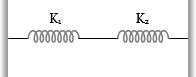
The effective spring constant of two spring system as shown in figure will be
A  particle of mass  $m$ is projected with velocity $v$ making an angle of $45^o $ with the horizontal. When the particle lands on the level ground the magnitude of the change in its momentum will be
The equation $\text{y}=\text{A}\sin^2(\text{kx}-\omega\text{t})$ represents a wave motion with:
The diagram shows two oscillations. What is the phase difference between the oscillations?
When a mass is rotating in a plane about a fixed point, its angular momentum is directed along