The period of a simple pendulum is doubled, when
Easy


Download our appand get started for free
Experience the future of education. Simply download our apps or reach out to us for more information. Let's shape the future of learning together!No signup needed.*
Similar Questions
- 1A particle is excuting a simple harmonic motion. Its maximum acceleration is $\alpha $ and maximum velocity is $\beta $. Then its frequency of vibration will beView Solution
- 2The kinetic energy and potential energy of a particle executing simple harmonic motion will be equal, when displacement (amplitude = $a$) isView Solution
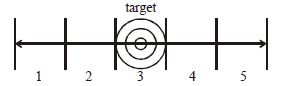
- 3View SolutionA shooting game involves using a gun that fires by itself at random times. The player can only point the gun in a fixed direction while the target moves from side to side with simple harmonic motion, as shown. At which of the given region should the player aim in order to score the greatest number of hits?
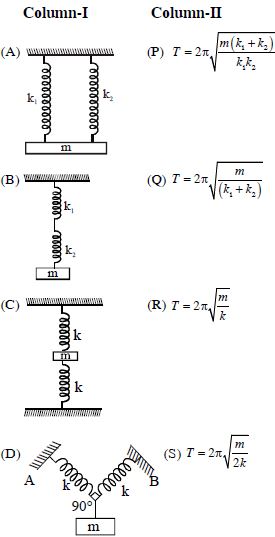
- 4In the following questions, match column $-I$ with column $-II$ and choose the correct optionsView Solution
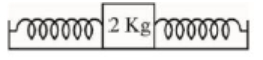
- 5A block of mass $2\,kg$ is attached with two identical springs of spring constant $20\,N / m$ each. The block is placed on a frictionless surface and the ends of the springs are attached to rigid supports (see figure). When the mass is displaced from its equilibrium position, it executes a simple harmonic motion. The time period of oscillation is $\frac{\pi}{\sqrt{x}}$ in SI unit. The value of $x$ is $..........$View Solution
- 6A particle executes a simple harmonic motion of time period $T$. Find the time taken by the particle to go directly from its mean position to half the amplitudeView Solution
- 7A pendulum has time period $T$. If it is taken on to another planet having acceleration due to gravity half and mass $ 9 $ times that of the earth then its time period on the other planet will beView Solution
- 8Two particles are executing simple harmonic motion of the same amplitude $A$ and frequency $\omega $ along the $x-$ axis. Their mean position is separated by distance $X_0 (X_0> A)$. If the maximum separation between them is $(X_0 +A)$, the phase difference between their motion isView Solution
- 9A particle is executing $SHM$ of amplitude $A,$ about the mean position $x = 0.$ Which of the following cannot be a possible phase difference between the positions of the particle at $x = +\,A/2$ and $x = - A/\sqrt {2} .$View Solution
- 10The equation of a simple harmonic motion is $X = 0.34\cos (3000t + 0.74)$ where $X$ and $t$ are in $mm$ and $sec$. The frequency of motion isView Solution