Question
Temperature coefficient of resistance of semiconductor is:

Answer

  1. Negative.

Need a full question paper?

Generate a complete, print-ready paper with questions like this in minutes — across 16+ boards, with answer keys.
Start Generating Free

Similar questions

Electric conduction takes place in a discharge tube due to the movement of:
Motion of a moving electron is not affected by (a) An electric field applied in the direction of motion(b) Magnetic field applied in the direction of motion(c) Electric field applied perpendicular to the direction of motion               (d) Magnetic field applied perpendicular to the direction of motion


A river is flowing from west to east at a speed of 5 metres per minute. A man on the south bank of the river, capable of swimming at 10 metres per minute in still water, wants to swim across the river in the shortest time. He should swim in a direction:
  1. Due north.
  2. 30° east of north.
  3. 30° north of west.
  4. 60° east of north.
Two point charges 10C and -10C are placed at a certain distance. What is the electric potential of their midpoint?
A radioactive decay chain starts from ${ }^{93^{ Np ^{237}}}$ and produces ${ }^{93^{ Np ^{287}}}$ by successive emissions. The emitted particles can be
When a charge of 3 coulombs is placed in a uniform electric field, it experiences a force of 3000 Newton. Within this field, potential difference between two points separated by a distance of 1 cm is(a) 10 volts(b) 90 volts(c) 1000 volts(d) 3000 volts
       
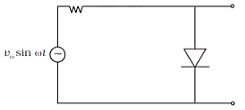
The output of the given circuit in Figure.
Image
If the potential difference applied to the tube is doubled and the separation between the filament and the target is also doubled, the cutoff wavelength:
The work function of a metal is $hv_{0.}$ Light of frequency $v$ falls on this metal. The photoelectric effect will take place only if:
Assertion  :   Conductors having equal positive charge and volume, must also have same potential.
Reason     :   Potential depends only on charge and volume of conductor. (a) If both assertion and reason are true and the reason is the correct explanation of the assertion.(b) If both assertion and reason are true but reason is not the correct explanation of the assertion.(c) If assertion is true but reason is false.(d) If the assertion and reason both are false.