Question
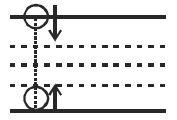
The phenomenon of interference is shown by

Answer

(d)Interference is shown by transverse as well as mechanical waves.

Need a full question paper?

Generate a complete, print-ready paper with questions like this in minutes — across 16+ boards, with answer keys.
Start Generating Free

Similar questions

A particle of mass $m$ moves in a circular orbit in a central potential field $U\left( r \right) = \frac{1}{2}k{r^2}$. If Bohr’s quantization conditions are applied, radii of possible orbits and energy levels vary with quantum number $n$ as
The charge in an $LC$ circuit with negligible resistance oscillates as given by equation $\frac{{{d^2}q}}{{d{t^2}}} + 16{\pi ^2}q = 0$. If the charge is maxiumum equal to $24\,\mu C$ at $t = 0$, find the charge at $t = \frac{1}{{12}}\,s$............$\,\mu C$
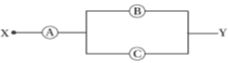
$A, \,B$ and $C$ are voltmeters of resistance $R, \,1 .5R$ and $3R$ respectively as shown in the figure. When some potential difference is applied between $X$ and $Y,$ the voltmeter readings are $V_A, \,V_B$ and $V_C$ respectively. Then
A long solenoid has $n$ turns per meter and current $I\, A$ is flowing through it. The magnetic field at the ends of the solenoid is
A micron is related to centimetre as
A man standing on the roof of a house of height $h$ throws one particle vertically downwards and another particle horizontally with the same velocity $u$. The ratio of their velocities when they reach the earth's surface will be
A vessel contains $110\,\,g$  of water. The heat capacity of the vessel is equal to $10\,\,g$ of water. The initial temperature of water in vessel is $10\,^oC.$  If $220\,\,g$  of hot water at $70\,^oC$  is poured in the vessel, the final temperature neglecting radiation loss, will be nearly equal to ........ $^oC$
How can we change a camera from $F / 4$ to $F / 5.6 ?$
When the electron in the hydrogen atom jumps from $2^{nd}$ orbit to $1^{st}$ orbit, the wavelength of radiation emitted is $\lambda$. When the electrons jump from $3^{rd}$ orbit to $1^{st}$ orbit, the wavelength of emitted radiation would be
A stone is projected vertically up from the bottom of a water tank. Assuming no water resistance it will go up and come down in same time but if water drag is present then the time it takes to go up, $t_{up}$ and the time it takes to come down, $t_{down}$ are related as