MCQ
The physical quantities not having same dimensions are
  • A
    Speed and ${({\mu _0}{\varepsilon _0})^{ - 1/2}}$
  • B
    Torque and work
  • Momentum and Planck's constant
  • D
    Stress and Young's modules

Answer

Correct option: C.
Momentum and Planck's constant
c
(c) Momentum $[ML{T^{ - 1}}]$, Planck's constant $[M{L^2}{T^{ - 1}}]$

Need a full question paper?

Generate a complete, print-ready paper with questions like this in minutes — across 16+ boards, with answer keys.
Start Generating Free

Similar questions

A body at rest may have
On mixing the salt in water, the surface tension of water will
A person is standing at $-2$ location on the number line. He runs to and fro from $-2$ to $+5$ location $5$ times. How much distance has he covered if he comes back to $-2$ location at the end?
How much work does a pulling force of $40 \,N$ do on the $20\, kg$ box in pulling it $8 \,m $ across the floor at a constant speed. The pulling force is directed at $60^o $ above the horizontal.....$J$
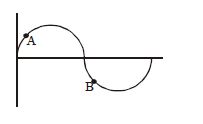
Consider the snapshot of a wave traveling in positive $x$ -direction
A motorist starting a car from rest accelerates uniformly to a speed of $v\, m/s$ in $9\, seconds$. He maintains this speed for another $50\, seconds$ and then applies the brakes and decelerates uniformly to rest. His deceleration is numberically equal to three times his previous acceleration. Then the time during which the deceleration takes place is ..........$s$ :-
The potential energy of a spring when stretched through a distance $x$ is $10J$. What is the amount of work done on the same spring to stretch it through an additional distance $x\ ?$
A bicycle tyre is filled with air having pressure of $270\,kPa$ at $27^{\circ}\,C$. The approximate pressure of the air in the tyre when the temperature increases to $36^{\circ}\,C$ is $............kPa$
A uniform wooden stick of mass $1.6 \mathrm{~kg}$ and length $l$ rests in an inclined manner on a smooth, vertical wall of height $h( < l)$ such that a small portion of the stick extends beyond the wall. The reaction force of the wall on the stick is perpendicular to the stick. The stick makes an angle of $30^{\circ}$ with the wall and the bottom of the stick is on a rough focr. The reaction of the wall on the stick is equal in magnitude to the reaction of the floor on the st $ck$. The ratio $h / l$ and the frictional force $f$ at the bottom of the stick are $\left(g=10 \mathrm{~m} \mathrm{~s}^{-2}\right)$
A circular disc of mass $M$ and radius $R$ is rotating about its axis with angular speed $\omega_{1}$ If another stationary disc having radius $\frac{ R }{2}$ and same mass $M$ is dropped co-axially on to the rotating disc. Gradually both discs attain constant angular speed $\omega_{2}$. The energy lost in the process is $p \%$ of the initial energy. Value of $p$ is