The plates of a capacitor are charged to a potential difference of $320 \, volts$ and are then connected across a resistor. The potential difference across the capacitor decays exponentially with time. After $1 $ second the potential difference between the plates of the capacitor is $240 \, volts$, then after $2$ and $3$ seconds the potential difference between the plates will be
Diffcult
Download our app for free and get started
(b) $V = {V_0}({e^{ - \lambda t}})$
After $1$ seconds
${V_1} = 320({e^{ - \lambda }}) \Rightarrow 240 = 320({e^{ - \lambda }})\, \Rightarrow \,{e^{ - \lambda }} = \frac{3}{4}$
After $2$ seconds
${V_2} = 320\,{({e^{ - \lambda }})^2} = 320 \times {\left( {\frac{3}{4}} \right)^2} = 180\,\,volt$
After $3$ seconds
${V_3} = 320\,{({e^{ - \lambda }})^3} = 320 \times {\left( {\frac{3}{4}} \right)^3} = 135\,\,volt$
After $1$ seconds
${V_1} = 320({e^{ - \lambda }}) \Rightarrow 240 = 320({e^{ - \lambda }})\, \Rightarrow \,{e^{ - \lambda }} = \frac{3}{4}$
After $2$ seconds
${V_2} = 320\,{({e^{ - \lambda }})^2} = 320 \times {\left( {\frac{3}{4}} \right)^2} = 180\,\,volt$
After $3$ seconds
${V_3} = 320\,{({e^{ - \lambda }})^3} = 320 \times {\left( {\frac{3}{4}} \right)^3} = 135\,\,volt$

Download our appand get started for free
Experience the future of education. Simply download our apps or reach out to us for more information. Let's shape the future of learning together!No signup needed.*
Similar Questions
- 1View SolutionA table tennis ball which has been covered with conducting paint is suspended by a silk thread so that it hang between two plates, out of which one is earthed and other is connected to a high voltage generator. This ball
- 2Given below are two statements: one is labelled as Assertion $A$ and the other is labelled as Reason $R$.View Solution
Assertion $A$: The potential ( $V$ ) at any axial point, at $2 \mathrm{~m}$ distance ( $r$ ) from the centre of the dipole of dipole moment vector $\vec{P}$ of magnitude, $4 \times 10^{-6} \mathrm{C} \mathrm{m}$, is $\pm 9 \times 10^3 \mathrm{~V}$.
(Take $\frac{1}{4 \pi \epsilon_0}=9 \times 10^9 \mathrm{Sl}$ units)
Reason $R$: $V= \pm \frac{2 P}{4 \pi \epsilon_0 r^2}$, where $r$ is the distance of any axial point, situated at $2 \mathrm{~m}$ from the centre of the dipole.
In the light of the above statements, choose the correct answer from the options given below:
- 3View SolutionA non uniformly shaped conductor is charged then at it's sharpest point
- 4A parallel plate capacitor with air between plates has a capacitance of $8\,\mu F$ what will be capacitance if distance between plates is reduced by half, and the space between them is filled with a substance of dielectric constant $6$ ?.....$\mu F$View Solution
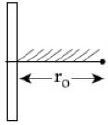
- 5A positive point charge is released from rest at a distance $r_0$ from a positive line charge with uniform density. The speed $(v)$ of the point charge, as a function of instantaneous distance $r$ from line charge, is proportional toView Solution
- 6An elementary particle of mass $m$ and charge $ + e$ is projected with velocity $v$ at a much more massive particle of charge $Ze,$ where $Z > 0.$What is the closest possible approach of the incident particleView Solution
- 7A parallel plate capacitor has plate area $40\,cm ^2$ and plates separation $2\,mm$. The space between the plates is filled with a dielectric medium of a thickness $1\,mm$ and dielectric constant $5$ . The capacitance of the system is :View Solution
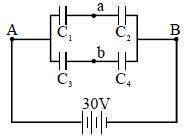
- 8Four capacitors with capacitances $C_1 = 1\,\mu F, C_2 = 1.5\,\mu F, C_3 = 2.5\,\mu F$ and $C_4 = 0.5\,\mu F$ are connected as shown and are connected to a $30\, volt$ source. The potential difference between points $a$ and $b$ is.....$V$View Solution
- 9In a region, the potential is represented by $V(x, y, z) = 6x - 8xy - 8y + 6yz$, where $V$ is in volts and $x, y, z$ are in metres. The electric force experienced by a charge of $2$ coulomb situated at point $( 1, 1, 1)$ isView Solution
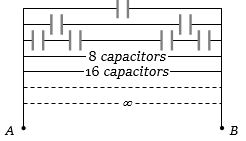
- 10An infinite number of identical capacitors each of capacitance $1\,\mu F$ are connected as in adjoining figure. Then the equivalent capacitance between $A$ and $B$ is......$\mu F$View Solution