MCQ
The pn junction can be formed by which of the following methods?
- AGrown junction method
- BAlloying method
- CDiffusion method
- DAll of these
Explanation:
Grown Junction Diode:
Diodes of this type are formed during the crystal pulling process. P and N-type impurities can be alternately added to the molten semiconductor material in the crucible, which results in a P-N junction when crystal is pulled. After slicing, the larger area device can then be cut into a large number of smaller-area semiconductor diodes. Though such diodes, because of larger area, are capable of handling large currents but larger area also introduces more capacitive effects, which are undesirable. Such diodes are used for low frequencies.
Alloy Type or Fused Junction Diode:
Generate a complete, print-ready paper with questions like this in minutes — across 16+ boards, with answer keys.
In a Ag voltameter 2.68 gm of silver is deposited in 10 min. The heat developed in 20Ω resistor during the same period will be

|
(a) 192 kJ |
(b) 192 J |
(c) 200 J |
(d) 132 kJ |
The resistance of a wire of iron is 10 ohms and temp. coefficient of resistivity is 5 . At 20
 it carries 30 milliamperes of current. Keeping constant potential difference between its ends, the temperature of the wire is raised to 120. The current in milliamperes that flows in the wire is
|
(a) 20 |
(b) 15 |
(c) 10 |
(d) 40 |
Electromagnetic waves are transverse in nature is evident by
|
(a) Polarization |
(b) Interference |
(c) Reflection |
(d) Diffraction |
What is immaterial for an electric fuse wire
|
(a) Its specific resistance |
(b) Its radius |
|
(c) Its length |
(d) Current flowing through it |
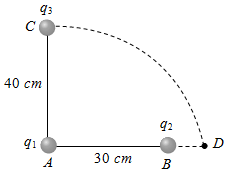
To charges  and
and  are placed 30 cm apart, shown in the figure. A third charge
  is moved along the arc of a circle of radius 40 cm from C to D. The change in the potential energy of the system is
  , where k is
|
(a) 8
|
(b) 
|
(c) 
|
(d) 
|