MCQ
The pn junction can be formed by which of the following methods?
  • A
    Grown junction method
  • B
    Alloying method
  • C
    Diffusion method
  • All of these

Answer

Correct option: D.
All of these
Grown Junction Diode:
Diodes of this type are formed during the crystal pulling process. $P$ and $N-$type impurities can be alternately added to the molten semiconductor material in the crucible, which results in a $P-N$ junction when crystal is pulled. After slicing, the larger area device can then be cut into a large number of smaller$-$area semiconductor diodes. Though such diodes, because of larger area, are capable of handling large currents but larger area also introduces more capacitive effects, which are undesirable. Such diodes are used for low frequencies.
Alloy Type or Fused Junction Diode: Such a diode is formed by first placing a $P-$ type impurity $($a tiny pellet of aluminium or some other $P-$ type impurity$)$ into the surface of an $N-$type crystal and heating the two until liquefaction occurs where the two materials meet. An alloy will result that on cooling will give a $P-N$ junction at the boundary of the alloy substrate. Similarly, an $N-$type impurity may be placed into the surface of a $P-$ type crystal and the two are heated until liquefaction occurs. Alloy type diodes have a high current rating and large $\text{PIV} ($peak inverse voltage$)$ rating. The junction capacitance is also large, due to the large junction area.

Need a full question paper?

Generate a complete, print-ready paper with questions like this in minutes — across 16+ boards, with answer keys.
Start Generating Free

Similar questions

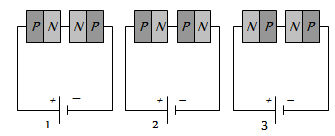
Two PN-junctions can be connected in series by three different methods as shown in the figure. If the potential difference in the junctions is the same, then the correct connections will be
A charged body has an electric flux $\phi$ associated with it. The body is now placed inside a metallic container. The flux $\phi$, outside the container will be
A free neutron decays into a proton but a free proton does not decay into neutron. This is because
The average kinetic energy of the thermal neutrons is of the order of (Boltzmann's constant $(K _{ B }=8 \times 10^{-5} eV /$ Kelvin) 
Coefficient of mutual inductance between two coils is 2.5 H . If current is changing in one coil at the rate of 1 $A / s$, then magnitude of induced emf in the secondary coil : $\quad \begin{array}{ll} & 0\end{array}$
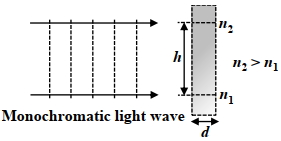
A monochromatic light wave is incident normally on a glass slab of thickness $d$, as shown in the figure. The refractive index of the slab increases linearly from $n_1$ to $n_2$ over the height $h$. Which of the following statement($s$) is (are) true about the light wave emerging out of the slab?

(image)

($A$) It will deflect up by an angle $\tan ^{-1}\left[\frac{\left(n_2^2-n_1^2\right) d}{2 h}\right]$

($B$) It will deflect up by an angle $\tan ^{-1}\left[\frac{\left(n_2-n_1\right) d}{h}\right]$

($C$) It will not deflect.

($D$) The deflection angle depends only on $\left(n_2-n_1\right)$ and not on the individual values of $n_1$ and $n_2$.
The toroid of radius $10 \ cm$ has $100$ turns. If a current of $0.1$ ampere is flowing in it, then the value of the magnetic field on the axis of the toroid will be:
The resistance of a wire is $5\,ohm$  at $50\,^o C$ and $6\,ohm $ at $100\,^o C$. The resistance of the wire at $0\,^o C$ will be .............. $\Omega$
The length of a metal wire is $l_1$ when the tension in it $T_1$ and is $l_2$ when the tension is $T_2$. The natural length of the wire is:
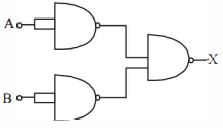
The combination of gates shown below yields