MCQ
The pointer of a dead-beat galvanometer gives a steady deflection because
  • Eddy currents are produced in the conducting frame over which the coil is wound
  • B
    Its magnet is very strong
  • C
    Its pointer is very light
  • D
    Its frame is made of abonite

Answer

Correct option: A.
Eddy currents are produced in the conducting frame over which the coil is wound
a
A galvanometer gives steady deflection.

The pointer of a dead-beat garranometer shouls steady state deflection as eddy-cumments are generated due to the coil coound. This eddy-cumment is due to the coil which is wound and produced in the conducting fuame.

Need a full question paper?

Generate a complete, print-ready paper with questions like this in minutes — across 16+ boards, with answer keys.
Start Generating Free

Similar questions

Two long parallel wires carrying currents $8\,A$ and $15\,A$ in opposite directions are placed at a distance of $7\,cm$ from each other. A point $P$ is at equidistant from both the wires such that the lines joining the point $P$ to the wires are perpendicular to each other. The magnitude of magnetic field at $P$ is $............\times 10^{-6}\,T$. (Given : $\left.\sqrt{2}=1.4\right)$
When a positive $q$ charge is taken from lower potential to a higher potential point, then its potential energy will
Which one did Rutherford consider to be supported by the results of experiments in which $\alpha -$particles were scattered by gold foil?
A long cylindrical shell carries positive surface charge $\sigma$ in the upper half and negative surface charge $-\sigma$ in the lower half. The electric field lines around the cylinder will look like figure given in : (figures are schematic and not drawn to scale)
If you are provided three resistances 2 $\Omega$, 3 $\Omega$ and 6 $\Omega$. How will you connect them so as to obtain the equivalent resistance of 4 $\Omega$
A uniform electric field of $20\, N/C$ exists along the $x$ -axis in a space. The potential  difference $(V_B -V_A)$ for the point $A(4\,m, 2\,m)$ and $B(6\,m, 5\,m)$ is.....$V$
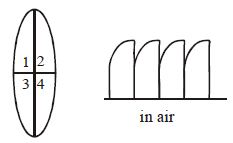
The given lens is broken into four parts rearranged as shown. If the initial focal length is $f$, then after rearrangement the equivalent focal length is
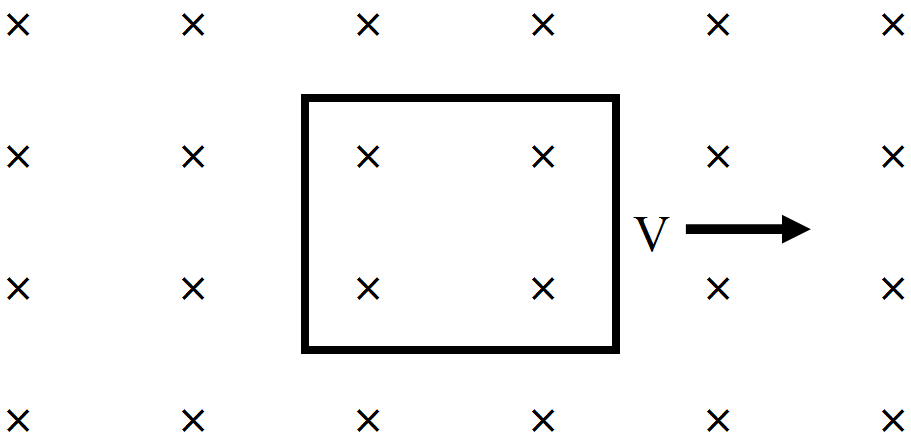
A conducting square loop of side l and resistance R moves in its plane with a uniform velocity u perpendicular to one of its sides. A uniform and constant magnetic field B exists along the perpendicular to the plane of the loop as shown in figure. The current induced in the loop is:
In Young's double slit experiment, $62$ fringes are seen in visible region for sodium light of wavelength $5893 Å$. If violet light of wavelength $4358 Å$ is used in place of sodium light, then number of fringes seen will be
When the light source is moving away, the Doppler effect for light is known as: