MCQ
“The position and velocity of a small particle like electron cannot be simultaneously determined.” This statement is
  • Heisenberg uncertainty principle
  • B
    Principle of de Broglie's wave nature of electron
  • C
    Pauli's exclusion principle
  • D
    Aufbau's principle

Answer

Correct option: A.
Heisenberg uncertainty principle
a
According to the. Heisenberg's uncertainty principal momentum and exact position of an $e^{\ominus}$ can not be detesmined simultaneously.

$\Delta x \cdot \Delta p \geq \frac{h}{4 \pi}$

Need a full question paper?

Generate a complete, print-ready paper with questions like this in minutes — across 16+ boards, with answer keys.

Start Generating Free

Similar questions

Which alkene is most stable
Assertion  : Aniline does not undergo Friedel- Crafts reaction.
Reason  : $-NH_2$ group of aniline reacts with $AlCl_3$ (Lewis acid) to give acid-base reaction
The electrochemical cell shown below is a concentration cell.

$M \mid M ^{2+}$ (saturated solution of a sparingly soluble salt, $\left.MX _2\right) \| M ^{2+}\left(0.001\right.$ mol dm $\left.d ^{-3}\right) \| M$ The emf of the cell depends on the difference in concetration of $M ^{2+}$ ions at the two electrodes. The emf of the cell at $298$ is $0.059 \ V$

$1.$ The solubility product $\left( K _{ sp } ; mol ^3 dm ^{-9}\right)$ of $MX _2$ at $298$ based on the information available the given concentration cell is (take $2.303 \times R \times 298 / F =0.059 \ V$ )

$(A)$ $1 \times 10^{-15}$ $(B)$ $4 \times 10^{-15}$

$(C)$ $1 \times 10^{-12}$ $(D)$ $4 \times 10^{-12}$

$2.$ The value of $\Delta G \left( kJ \ mol ^{-1}\right)$ for the given cell is (take $1 F =96500 \ C \ mol ^{-1}$ )

$(A)$ $-5.7$ $(B)$ $5.7$ $(C)$ $11.4$ $(D)$ $-11.4$

Give the answer question $1$ and $2.$
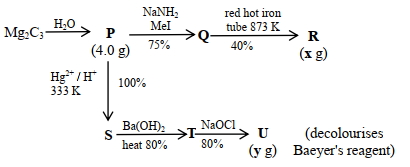
For the following reaction scheme, percentage yields are given along the arrow :

$x g$ and $y g$ are mass of $R$ and $U$, respectively.

(Use : Molar mass (in $g mol { }^{-1}$ ) of $H , C$ and $O$ as $1,12$ and $16$ , respectively)

($1$) The value of $x$ is

($2$) The value of $y$ is

Give thwe answer or quetion ($1$) and ($1$)

The treatment of an aqueous solution of $3.74 g$ of $\ce{Cu\left(NO_3\right)_2}$ with excess $KI$ results in a brown solution along with the formation of a precipitate. Passing $H _2 S$ through this brown solution gives another precipitate $X$. The amount of $X ($in $g)$ is $......[$Given : Atomic mass of $H =1, N =14, O =16, S =32, K =39, Cu =63, I =127 ]$
The vapour pressure of a liquid depends on
The molar conductivities $\Lambda _{NaOH}^o$ and $\Lambda _{HCl}^o$ at infinite dilution in water at $25^o C$ are $91.0$ and $426.2\, S \,cm^2/mol$ respectively. To calculate $\Lambda _{HOAc}^o,$ the additional value required is
$'A'$ and $'B'$ in the following reactions are ${image}$
The trace metal present in insulin is
Molarity $(M)$ of an aqueous solution containing $\mathrm{x} g$ of anhyd. $\mathrm{CuSO}_4$ in $500 \mathrm{~mL}$ solution at $32^{\circ} \mathrm{C}$ is $2 \times 10^{-1} \mathrm{M}$. Its molality will be. . . . . .$\times 10^{-3} \mathrm{~m}$ (nearest integer). [Given density of the solution $=1.25 \mathrm{~g} / \mathrm{mL}$.]