MCQ
The position coordinates of a projectile projected from ground on a certain planet (with no atmosphere) are given by $y=\left(4 t-2 t^2\right) m$ and $x =(3 t)$ metre, where $t$ is in second and point of projection is taken as origin. The angle of projection of projectile with vertical is .........
  • A
    $30$
  • $37$
  • C
    $45$
  • D
    $60$

Answer

Correct option: B.
$37$
b
(b)

$y=4 t-2 t^2$

$x=3 t$

$V=V_{x \hat{i}}+V_{y \hat{j}}$

$V_x=\frac{d x}{d t}, V_y=\frac{d y}{d t}$

$V_x=3, V_y=4-4 t$

for $t=0, V_y=4$

$\tan \theta=\frac{V_y}{V_x}=\frac{4}{3}$

$\theta=53^{\circ}$ with horizontal

With vertical

$\theta=37^{\circ}$

Need a full question paper?

Generate a complete, print-ready paper with questions like this in minutes — across 16+ boards, with answer keys.

Start Generating Free

Similar questions

How many wavelength of $K{r^{86}}$ are there in one metre
Which of the following parameters is the same for molecules of all gases at a given temperature?
A bullet is fired from a gun at the speed of $280\,ms ^{-1}$ in the direction $30^{\circ}$ above the horizontal. The maximum height attained by the bullet is $........\,m$ $\left(g=9.8\,ms ^{-2}, \sin 30^{\circ}=0.5\right):-$
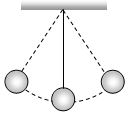
What is the velocity of the bob of a simple pendulum at its mean position, if it is able to rise to vertical height of $10cm$  ......... $m/s$ (Take $g = 9.8\,m/{s^2})$
In an electric circuit containing a battery, the charge (assumed positive) inside the battery:
  1. Always goes from the positive terminal to the negative terminal.
  2. May go from the positive terminal to the negative terminal.
  3. Always goes from the negative terminal to the positive terminal
  4. Does not move.
Force in Column - $\mathrm{I}$ and its use is in Column - $\mathrm{II}$ are given. Match them appropriately.
Column - $\mathrm{I}$ Column - $\mathrm{II}$
$(a)$ Cohesive force $(i)$ Useful for writing by chalk on blackboard.
$(b)$ Adhesive force $(ii)$ Useful in soldering.
  $(iii)$Useful for formation of spherical drops of liquid.
Density of rubber is $​d$​. $​ A$​ thick rubber cord of length $​L$​ and cross-section area $​A$​ undergoes elongation under its own weight on suspending it. This elongation is proportional to
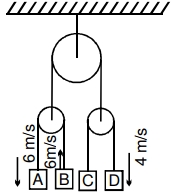
In the figure shown the velocity of different blocks is shown. The velocity of $C$ is $.........\,m/s$
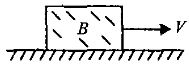
A block $B$ is pushed momentarily along a horizontal surface with an initial velocity $V.$ If $\mu $ is the coefficient of sliding friction between $B$ and the surface, block $B$ will come to rest after a time
A uniform capillary tube of inner radius $r$ is dipped vertically into a beaker filled with water. The water rises to a height $h$ in the capillary tube above the water surface in the beaker. The surface tension of water is $\sigma$. The angle of contact between water and the wall of the capillary tube is $\theta$. Ignore the mass of water in the meniscus. Which of the following statements is (are) true?

$(A)$For a given material of the capillary tube, $\mathrm{h}$ decreases with increase in $\mathrm{r}$.

$(B)$ For a given material of the capillary tube, $\mathrm{h}$ is independent of $\sigma$

$(C)$ If this experiment is performed in a lift going up with a constant acceleration, then $\mathrm{h}$ decreases

$(D)$ $\mathrm{h}$ is proportional to contact angel $\theta$