The positive temperature coefficient of resistance is for
Easy


Download our appand get started for free
Experience the future of education. Simply download our apps or reach out to us for more information. Let's shape the future of learning together!No signup needed.*
Similar Questions
- 1A letter $'A'$ is constructed of a uniform wire with resistance $1.0\,\Omega $ per $cm$ , The sides of the letter are $20\, cm$ and the cross piece in the middle is $10\, cm$ long. The apex angle is $60$ . The resistance between the ends of the legs is close to ................ $\Omega$View Solution
- 2One end of a Nichrome wire of length $2\,L$ and cross-sectional area $A$ is attatched to an end of another Nichrome wire of length $L$ and cross-sectional area $2\,A$. If the free end of the longer wire is at an electric potential of $8.0$ $\mathrm{volts}$, and the free end of the shorter wire is at an electric potential of $1.0$ $\mathrm{volt}$, the potential at the junction of the two wires is equal to ............. $V$View Solution
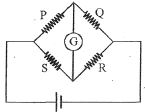
- 3Resistances are arranged in a cyclic order to form a balanced wheatstone bridge as shown in figure. Ratio of power consumed in the branches $P + Q$ and $R + S$ isView Solution
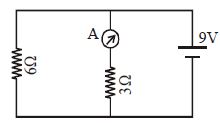
- 4In the figure shown, if the internal resistance of the battery is $1\, ohm$, the reading of the ammeter will be ............... $A$View Solution
- 5When two resistance are connected in parallel then the equivalent resistance is $\frac {6}{5}\Omega $ . When one of the resistance is removed then the effective resistance is $2\, \Omega $. The resistance of the wire removed will be ................ $\Omega$View Solution
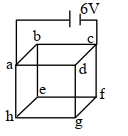
- 6Twelve wires each having resistance $2 \Omega$ are joined to form a cube. A battery of $6 \mathrm{~V}$ emf is joined across point $\mathrm{a}$ and $\mathrm{c}$. The voltage difference between $e$ and $f$ is.______.V.View Solution
- 7It is preferable to measure the $e.m.f.$ of a cell by potentiometer than by a voltmeter because of the following possible reasons.View Solution
$(i)$ In case of potentiometer, no current flows through the cell.
$(ii)$ The length of the potentiometer allows greater precision.
$(iii)$ Measurement by the potentiometer is quicker.
$(iv)$ The sensitivity of the galvanometer, when using a potentiometer is not relevant.
Which of these reasons are correct? - 8Three resistors are connected to form the sides of a triangle $ABC$, the resistance of the sides $AB$, $BC$ and $CA$ are $40\,ohms$, $60\,ohms$ and $100\,ohms$ respectively. The effective resistance between the points $A$ and $B$ in $ohms$ will beView Solution
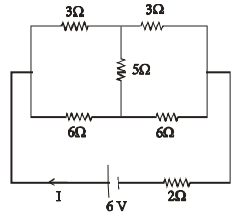
- 9A battery of $6\,V$ is connected to the circuit as shown below. The current I drawn from the battery is:View Solution
- 10The power rating of an electric motor which draws a current of $3.75\, amperes$ when operated at $200\, V$ is aboutView Solution