MCQ
The potential barrier, in the depletion layer, is due to
  • Ions
  • B
    Holes
  • C
    Electrons
  • D
    Both $(b)$ and $ (c)$ 

Answer

Correct option: A.
Ions
a
(a) The depletion layer is the region at the junction of a diode which is devoid of ions. Therefore the potential barrier in the depletion layer is due to ions.

Need a full question paper?

Generate a complete, print-ready paper with questions like this in minutes — across 16+ boards, with answer keys.
Start Generating Free

Similar questions

A candle flame of $3\, cm$ is placed at $3\, m$ from a wall. A concave mirror is kept at distance $x$ from the wall in such a way that image of the flame on the wall is $9\, cm$. Then $x$ is......$cm$
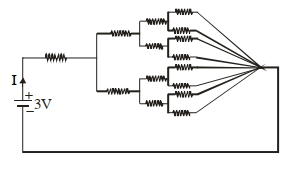
All resistances in figure are $1\,\Omega$ each. The value of current ' $I$ ' is $\frac{a}{5}\,A$. The value of $a$ is
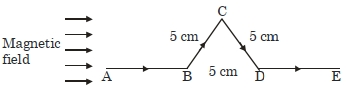
A triangular shaped wire carrying $10 A$ current is placed in a uniform magnetic field of $0.5\,T$, as shown in figure. The magnetic force on segment $CD$ is $....N$ $($ Given $BC = CD = BD =5\,cm )$.
The maximum number of possible interference maxima for slit-separation equal to twice the wavelength in Young’s double-slit experiment is
In the Bohr model of the hydrogen atom, let $R, v$ and $E$ represent the radius of the orbit, the speed of electron and the total energy of the electron respectively. Which of the following quantity is proportional to the quantum number $n$
A reflecting telescope utilizes
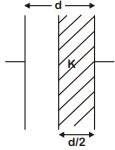
A parallel plate capacitor having crosssectional area $A$ and separation $d$ has air in between the plates. Now an insulating slab of same area but thickness $d/2$ is inserted between the plates as shown in figure having dielectric constant $K (=4) .$ The ratio of new capacitance to its original capacitance will be,
Comparing real and virtual images, we may say that:
The average value of electric energy density in an electromagnetic wave is :
The work function of a substance is $4.0 \,eV$. The longest wavelength of light that can cause photoelectron emission from this substance is approximately ......... $nm$