Question
The potential difference between the points $P$ and $Q$ in the adjoining circuit will be :-
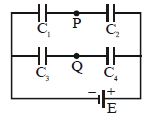
$\left(\mathrm{V}_{\mathrm{P}}-\mathrm{O}\right) \cdot \mathrm{C}_{1}=\left(\mathrm{E}-\mathrm{V}_{\mathrm{P}}\right) \mathrm{C}_{2}$
$\mathrm{V}_{\mathrm{P}}=\frac{\mathrm{C}_{2} \mathrm{E}}{\mathrm{C}_{1}+\mathrm{C}_{2}}$
$\mathrm{C}_{3} $ and $ \mathrm{C}_{4}$ are in series,
charge on each will remain same,
$\left(\mathrm{V}_{\mathrm{Q}}-\mathrm{0}\right) \cdot \mathrm{C}_{3}=\left(\mathrm{E}-\mathrm{V}_{\mathrm{Q}}\right) \mathrm{C}_{4}$
$\mathrm{V}_{\mathrm{Q}}=\frac{\mathrm{C}_{4} \mathrm{E}}{\mathrm{C}_{3}+\mathrm{C}_{4}}$
Hence $\mathrm{V}_{\mathrm{P}}-\mathrm{V}_{\mathrm{Q}}=\frac{\left(\mathrm{C}_{2} \mathrm{C}_{3}-\mathrm{C}_{1} \mathrm{C}_{4}\right) \mathrm{E}}{\left(\mathrm{C}_{1}+\mathrm{C}_{2}\right)\left(\mathrm{C}_{3}+\mathrm{C}_{4}\right)}$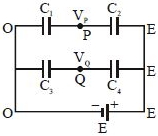
Generate a complete, print-ready paper with questions like this in minutes — across 16+ boards, with answer keys.