Two metal spheres $A$ and $B$ of radii $a$ and $b(a < b)$ respectively are at a large distance apart. Each sphere carries a charge of $100 \mu C$. The spheres are connected by a conducting wire, then
Easy
Download our app for free and get started
(a)
$V_A=\frac{k(100)}{a} \quad V_B=\frac{k(100)}{b}$
$a < b$
$V_a > V_B$
Charge flows from $A$ to $B$.

Download our appand get started for free
Experience the future of education. Simply download our apps or reach out to us for more information. Let's shape the future of learning together!No signup needed.*
Similar Questions
- 1Figure shows two equipotential lines in $x, y$ plane for an electric field. The scales are marked. The $x-$ component $E_x$ and $y$ -component $E_y$ of the electric field in the space between these equipotential lines are respectively :-View Solution
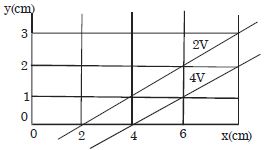
- 2Twenty seven drops of same size are charged at $220\, \mathrm{~V}$ each. They combine to form a bigger drop. Calculate the potential of the bigger drop. (In $\mathrm{~V}$)View Solution
- 3The electric potential $V(x, y, z)$ for a planar charge distribution is given by:View Solution
$V\left( {x,y,z} \right) = \left\{ {\begin{array}{*{20}{c}}
{0\,\,\,\,\,\,\,\,\,\,\,\,\,\,\,\,\,\,\,\,\,\,\,\,\,\,\,\,\,\,\,\,\,\,\,for\,x\, < \, - d}\\
{ - {V_0}{{\left( {1 + \frac{x}{d}} \right)}^2}\,\,\,\,\,\,\,\,\,\,\,\,\,\,\,\,\,\,for\, - \,d\, \le x < 0}\\
{ - {V_0}\left( {1 + 2\frac{x}{d}} \right)\,\,\,\,\,\,\,\,\,\,\,for\,0\, \le x < d}\\
{ - 3{V_0}\,\,\,\,\,\,\,\,\,\,\,\,\,\,\,\,\,\,\,\,\,\,\,\,\,\,for\,x\, > \,d}
\end{array}} \right.$where $-V_0$ is the potential at the origin and $d$ is a distance. Graph of electric field as a function of position is given as
- 4A capacitor of capacitance $9 n F$ having dielectric slab of $\varepsilon_{ r }=2.4$ dielectric strength $20\, MV / m$ and $P.D. =20 \,V$ then area of plates is ....... $\times 10^{-4}\, m ^{2}$View Solution
- 5Two capacitors of $10\,\mu \,F$ and $20\,\mu \,F$ are connected in series with a $30\,V$ battery. The charge on the capacitors will be, respectivelyView Solution
- 6A parallel plate capacitor with plate area $'A'$ and distance of separation $'d'$ is filled with a dielectric. What is the capacity of the capacitor when permittivity of the dielectric varies as :View Solution
$\varepsilon(x)=\varepsilon_{0}+k x, \text { for }\left(0\,<\,x \leq \frac{d}{2}\right)$
$\varepsilon(x)=\varepsilon_{0}+k(d-x)$, for $\left(\frac{d}{2} \leq x \leq d\right)$
- 7Three condensers each of capacitance $2F$ are put in series. The resultant capacitance is.........$F$View Solution
- 8Two conducting spheres of radii $R_1$ and $R_2$ are charged with charges $Q_1$ and $Q_2$ respectively. On bringing them in contact there isView Solution
- 9The equivalent capacitance between $A$ and $B$ is.......$\mu \,F$View Solution
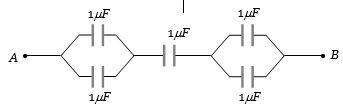
- 10View SolutionA parallel plate capacitor after charging is kept connected to a battery and the plates are pulled apart with the help of insulating handles. Now which of the following quantities will decrease?