The potential energy of a particle executing S.H.M. is $ 2.5\, J$, when its displacement is half of amplitude. The total energy of the particle be .... $J$
Medium


Download our appand get started for free
Experience the future of education. Simply download our apps or reach out to us for more information. Let's shape the future of learning together!No signup needed.*
Similar Questions
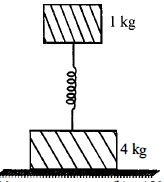
- 1Two bodies of masses $1\, kg$ and $4\, kg$ are connected to a vertical spring, as shown in the figure. The smaller mass executes simple harmonic motion of angular frequency $25\, rad/s$, and amplitude $1.6\, cm$ while the bigger mass remains stationary on the ground. The maximum force exerted by the system on the floor is ..... $N$ ( take $g = 10\, ms^{-2}$)View Solution
- 2A simple harmonic oscillator has an amplitude a and time period $T$. The time required by it to travel from $x = a$ to $x = \frac{a }{2}$ isView Solution
- 3View SolutionA particle is moving in a circle with uniform speed. Its motion is
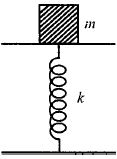
- 4A mass $m = 1.0\,kg$ is put on a flat pan attached to a vertical spring fixed on the ground. The mass of the spring and the pan is negligible. When pressed slightly and released, the mass executes simple harmonic motion. The spring constant is $500\,N/m.$ What is the amplitude $A$ of the motion, so that the mass $m$ tends to get detached from the pan ? (Take $g = 10\,m/s^2$ ). The spring is stiff enough so that it does not get distorted during the motion.View Solution
- 5The function $(sin\,\omega t -cos\,\omega t)$ representsView Solution
- 6A particle moves in space according to equationView Solution
$\vec r = (\sin \,t\,\hat i\, + \,\cos \,t\,\hat j\, + \,t\,\hat k)m$
Find time $'t'$ when position vector and acceleration vector are perpendicular to each other
- 7Two springs have spring constants ${K_A}$ and ${K_B}$ and ${K_A} > {K_B}$. The work required to stretch them by same extension will beView Solution
- 8The maximum velocity of a particle, executing simple harmonic motion with an amplitude $7\ mm$, is $4.4\ m/s$. The period of oscillation is .... $sec$View Solution
- 9The motion of a particle represented by $y\ =$ $\sin \omega t - \cos \omega t$ isView Solution
- 10The resultant of two rectangular simple harmonic motions of the same frequency and equal amplitudes but differing in phase by $\frac{\pi }{2}$ isView Solution