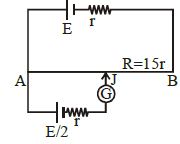
The potentiometer wire $AB$ is $600\,\, cm$ long at what distance from $A$ should the Jockey $J$ touch the wire to get zero deflection in the galvanomenter ................ $\mathrm{cm}$
Medium


Download our appand get started for free
Experience the future of education. Simply download our apps or reach out to us for more information. Let's shape the future of learning together!No signup needed.*
Similar Questions
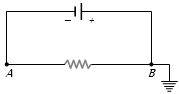
- 1A battery is connected to a uniform resistance wire $AB$ and $B$ is earthed. Which one of the graphs below shows how the current density $J$ varies along $AB$View Solution
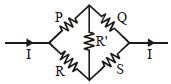
- 2Wheat stone bridge is balanced. Find ratio of electric power dissipated in $(P + Q)$ to $(R + S)$View Solution
- 3Voltmeters $V_1$ and $V_2$ are connected in series across a $D.C.$ line. $V_1$ reads $80\, volts$ and has a per volt resistance of $200 \,\Omega$. $V_2$ has a total resistance of $32 \,kilo-ohms$. The line voltage is .............View Solution
- 4An infinite line charge of uniform electric charge density i. lies along the axis of an electrically conducting infinite cylindrical shell of radius $R$. At time $t=0$, the space inside the cylinder is filled with a material of permittivity $\varepsilon$ and electrical conductivity $\sigma$. The electrical conduction in the material follows Ohm's law. Which one of the following graphs best describes the subsequent variation of the magnitude of current censity $j(t)$ at any point in the material?View Solution
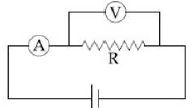
- 5The actual value of resistance $R$, shown in the figure is $30\,\Omega $. This is measured in an experiment as shown using the standard formula $R = \frac{V}{I}$ where $V$ and $I$ are the readings of the voltmeter and ammeter, respectively. If the measured value of $R$ is $5\%$ less, then the internal resistance of the voltmeter is ................. $\Omega$View Solution
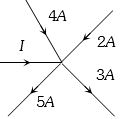
- 6In the given current distribution what is the value of $I$ .............. $A$View Solution
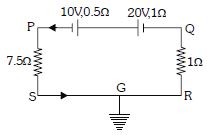
- 7View SolutionIn the circuit shown in the figure below, which of the following statement is incorrect ?
- 8The internal resistance of a primary cell is $4\, ohm$. It generates a current of $0.2\, amp$ in an external resistance of $21\, ohm$. The rate at which chemical energy is consumed in providing the current is .............. $J/s$View Solution
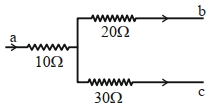
- 9Figure shows a part of an electric circuit. The potentials at points $a , b$ and $c$ are $30\,V , 12\,V$ and $2\,V$ respectively. The current through the $20 \Omega$ resistor will be $........\,A$View Solution
- 10If an electric heater is rated at $1000\, W$, then the time required to heat one litre of water from $20\,^oC$ to $60\,^oC$ isView Solution