Question
The power loss is less in transmission lines, when:

Answer

The power cables have some resistance.
Power lost in the wires can be calculated as $P = I^2R$ with $R$ as the resistance of the wires and $I$ as the current that passes through them.
Power at the load is $P = VI.$
From this one can see that if voltage is increased by say $n$ times,
then only $\frac{1}{\text{n}}$​ the current is required to deliver the same power.
However, if $\frac{1}{\text{n}}$​ current is passed
on the same wires, only $\frac{1}{\text{n}^2}$ of the power will be lost.

Need a full question paper?

Generate a complete, print-ready paper with questions like this in minutes — across 16+ boards, with answer keys.

Start Generating Free

Similar questions

Two thick wires and two thin wires, all of the same materials and same length form a square in the three different ways $P, Q$ and $R$ as shown in fig with current connection shown, the magnetic field at the centre of the square is zero in cases
If there are $n$ capacitors in parallel connected to $V$ volt source, then the energy stored is equal to
 
Which of the following is not true for electromagnetic waves?
If the distance between the plates of parallel plate capacitor is halved and the dielectric constant of dielectric is doubled, then its capacity will(a) Increase by 16 times(b) Increase by 4 times(c) Increase by 2 times(d) Remain the same
   
   
A semi conductor device with both active and passive electronic elements diffused into a silicon water to form a functional circuit is called.
The limit of resolution of eye is approximately:
The ratio of the energy of an $X-$ray photon of wavelength $1 \mathring A$ to that of visible light of wavelength $5000 \mathring A$ is
The wavelength $\lambda$, frequency $v$, velocity $v$ and intensity I of a light ray transmitted in air respectively. If this ray enters water, then the values of these quantities become $\lambda^{\prime}, \nu^{\prime}, v^{\prime}$ and $I^{\prime}$ respectively. Which of the following relations is correct?
When a bar magnet falls through a long hollow metal cylinder fixed with its axis vertical, the final acceleration of the magnet is(a) Equal to zero(b) Less than g(c) Equal to g(d) Equal to g in to beginning and then more than g


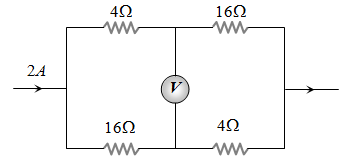
In the circuit shown below, The reading of the voltmeter $V$ is