The pressure of a medium is changed from $1.01 × 10^5$ $Pa$ to $1.165 × 10^5$ $Pa$ and change in volume is $10\% $ keeping temperature constant. The Bulk modulus of the medium is
Medium


Download our appand get started for free
Experience the future of education. Simply download our apps or reach out to us for more information. Let's shape the future of learning together!No signup needed.*
Similar Questions
- 1An increases in pressure required to decreases the $200\,\,litres$ volume of a liquid by $0.004\%$ in container is ........... $kPa$. (Bulk modulus of the liquid $= 2100\,\,MPa$ )View Solution
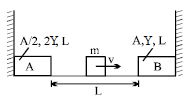
- 2In the given figure, two elastic rods $A$ & $B$ are rigidly joined to end supports. $A$ small mass $‘m’$ is moving with velocity $v$ between the rods. All collisions are assumed to be elastic & the surface is given to be frictionless. The time period of small mass $‘m’$ will be : [$A=$ area of cross section, $Y =$ Young’s modulus, $L=$ length of each rod ; here, an elastic rod may be treated as a spring of spring constant $\frac{{YA}}{L}$ ]View Solution
- 3A wire elongates by $l$ $mm$ when a load $W$ is hanged from it. If the wire goes over a pulley and two weights $W$ each are hung at the two ends, the elongation of the wire will be (in $mm$)View Solution
- 4Two exactly similar wires of steel and copper are stretched by equal forces. If the total elongation is $2 \,cm$, then how much is the elongation in steel and copper wire respectively? Given, $Y_{\text {steel }}=20 \times 10^{11} \,dyne / \ cm ^2$, $Y_{\text {copper }}=12 \times 10^{11} \,dy ne / \ cm ^2$View Solution
- 5A wire of area of cross-section ${10^{ - 6}}{m^2}$ is increased in length by $0.1\%$. The tension produced is $1000 N$. The Young's modulus of wire isView Solution
- 6Two wires of equal lengths are made of the same material. Wire $A$ has a diameter that is twice as that of wire $B$. If identical weights are suspended from the ends of these wires, the increase in length isView Solution
- 7View SolutionModulus of rigidity of diamond is
- 8A spherical ball contracts in volume by $0.02 \%$, when subjected to a normal uniform pressure of $50$ atmosphere. The Bulk modulus of its material is ............. $Nm ^{-2}$View Solution
- 9A uniformly tapering conical wire is made from a material of Young's modulus $Y$ and has a normal, unextended length $L.$ The radii, at the upper and lower ends of this conical wire, have values $R$ and $3R,$ respectively. The upper end of the wire is fixed to a rigid support and a mass $M$ is suspended from its lower end. The equilibrium extended length, of this wire, would equalView Solution
- 10A cubical solid aluminium (bulk modulus $=-V \frac{ dP }{ dV }=70 GPa$ ) block has an edge length of $1 m$ on the surface of the earth. It is kept on the floor of a $5 km$ deep ocean. Taking the average density of water and the acceleration due to gravity to be $10^3 kg m ^{-3}$ and $10 ms ^{-2}$, respectively, the change in the edge length of the block in $mm$ is . . . . .View Solution