MCQ
The process by which $ac$ is converted into $dc$ is known as
  • A
    Purification
  • B
    Amplification
  • Rectification
  • D
    Current amplification

Answer

Correct option: C.
Rectification
c
The process by which ac is converted into dc is known as "$Rectification$".

Need a full question paper?

Generate a complete, print-ready paper with questions like this in minutes — across 16+ boards, with answer keys.
Start Generating Free

Similar questions

$10\,gm$ of ice at $0\,^oC$ is mixed with $'m'\,gm$ of water at $50\,^oC$ . ........ $gm$ is minimum value of $m$ so that ice melts completely. ( $L_f = 80\,cal/gm$ and $S_W = 1\,cal/gm-\,^oC$ )
An open pipe is in resonance in its $2^{nd}$ harmonic with tuning fork of frequency ${f_1}$. Now it is closed at one end. If the frequency of the tuning fork is increased slowly from ${f_1}$ then again a resonance is obtained with a frequency ${f_2}$. If in this case the pipe vibrates ${n^{th}}$ harmonics then
The amplification factor of a triode valve is $15$. If the grid voltage is changed by $0.3 \,volt$  the change in plate voltage in order to keep the plate current constant (in volt) is
A system consists of two types of gas molecules $A$ and $B$ having same number density $2 \times$ $10^{25}\, / {m}^{3}$. The diameter of ${A}$ and ${B}$ are $10\, \stackrel{\circ}{{A}}$ and $5\, \stackrel{\circ}{{A}}$ respectively. They suffer collision at room temperature. The ratio of average distance covererd by the molecule $A$ to that of $B$ between two successive collision is $.....\,\times 10^{-2}$
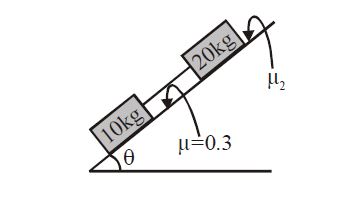
Value of $\theta$  is increased gradually from $\theta  = 0$ At $\theta=tan^{-1}(\frac{1}{2})$ both the block just start slipping. Then value of $\mu_2$ is : $(g = 10 m/s^2)$
Calculate the mean $\%$ error in five observation

$80.0,80.5,81.0,81.5,82$

Two vibrating tuning forks produce progressive waves given by $Y_1 = 4\, sin\, 500\pi t$ and $Y_2 = 2\, sin\, 506\, \pi t$ Number of beats produced per minute is 
In a Young’s double slit experiment, the path difference, at a certain point on the screen, between two interfering waves is $1/8^{th}$ of wavelength. The ratio of the intensity at this point to that at the centre of a bright fringe is close to
Two, spring $P$ and $Q$ of force constants $k_p$ and ${k_Q}\left( {{k_Q} = \frac{{{k_p}}}{2}} \right)$ are stretched by applying forces of equal magnitude. If the energy stored in $Q$ is $E$, then the energy stored in $P$ is
$R - C \equiv N + SnC{l_2} + HCl \longrightarrow A\xrightarrow{{{H_2}{O^ \oplus }}}RCHO$ Above reaction is known as