MCQ
The property between two charged ebonite rods is:
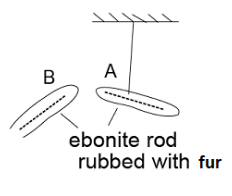
- AAttraction
- BRepulsion
- CBoth
- DNone
Explanation:
If two ebonite rods A and B are separately rubbed with fur and then they are brought near each other, they repel each other.
Generate a complete, print-ready paper with questions like this in minutes — across 16+ boards, with answer keys.
Polarised glass is used in sun glasses because
|
(a) It reduces the light intensity to half an account of polarisation |
|
(b) It is fashionable |
|
(c) It has good colour |
|
(d) It is cheaper |
The magnetic induction at a point P which is distant 4 cm from a long current carrying wire is  . The field of induction at a distance 12 cm from the same current would be
|
(a) 3.33 |
(b) 1.11 |
(c) 3 |
(d) 9 |
Resistance in the two gaps of a meter bridge are 10 ohm and 30 ohm respectively. If the resistances are interchanged the balance point shifts by
|
(a) 33.3 cm |
(b) 66.67cm |
(c) 25 cm |
(d) 50 cm |
A proton and an α - particle enter a uniform magnetic field perpendicularly with the same speed. If proton takes 25 μ sec to make 5 revolutions, then the periodic time for the α - particle would be
|
(a) 50 μ sec |
(b) 25 μ sec |
(c) 10 μ sec |
(d) 5 μ sec |


