MCQ
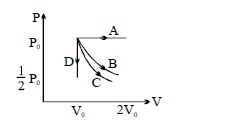
The $PV$ diagram shows four different possible reversible processes performed on a monatomic ideal gas. Process $A$ is isobaric (constant pressure). Process $B$ is isothermal (constant temperature). Process $C$ is adiabatic. Process $D$ is isochoric (constant volume). For which process$(es)$ does the temperature of the gas decrease?
  • A
    Process $A$ only
  • B
    Process $C$ only
  • Only Processes $C$ and $D$
  • D
    Only Processes $B$, $C$ and $D$

Answer

Correct option: C.
Only Processes $C$ and $D$
c
In $A$ temperature will increase

in $B$ temperature remains constant

in $C \& D$ temperature decrease.

Hence, option $C$ is the correct answer.

Need a full question paper?

Generate a complete, print-ready paper with questions like this in minutes — across 16+ boards, with answer keys.

Start Generating Free

Similar questions

The period of oscillation of a simple pendulum of constant length at earth surface is $T$. Its period inside a mine is
The velocity with which a projectile must be fired so that it escapes earth’s gravitation does not depend on
A batsman deflects a ball by an angle of $45^o$ without changing its initial speed which is equal to $54\; km/h$. What is the impulse imparted to the ball in $kg\;m/s$? (Mass of the ball is $0.15 \;kg.)$
$STATEMENT$-$1$ A block of mass $\mathrm{m}$ starts moving on a rough horizontal surface with a velocity $\mathrm{v}$. It stops due to friction between the block and the surface after moving through a certain distance. The surface is now tilted to an angle of $30^{\circ}$ with the horizontal and the same block is made to go up on the surface with the same initial velocity $v$. The decrease in the mechanical energy in the second situation is smaller than that in the first situation. because

$STATEMENT$- $2$ The coefficient of friction between the block and the surface decreases with the increase in the angle of inclination.

A particle executing $SHM$ of amplitude $4\,cm$ and $T = 4s.$ The time taken by it to move from $+2\,cm$ to $+2\sqrt 3\,cm$ is
Given : $\sigma$ is the compressibility of water, $\rho$ is the density of water and $K$ is the  bulk modulus of water. What is the energy density of water at the bottom of a lake $‘h’$  metre deep ?
A block of mass $10\, kg$ starts sliding on a surface with an initial velocity of $9.8\, ms ^{-1}$. The coefficient of friction between the surface and bock is $0.5$. The distance covered by the block before coming to rest is: [use $g =9.8\, ms ^{-2}$ ].........$m$
An air bubble of volume $1\,cm ^3$ rises from the bottom of a lake $40\,m$ deep to the surface at a temperature of $12^{\circ}\,C$. The atmospheric pressure is $1 \times 10^5 Pa$, the density of water is $1000\,kg / m ^3$ and $g =10\,m / s ^2$. There is no difference of the temperature of water at the depth of $40\,m$ and on the surface. The volume of air bubble when it reaches the surface will be $..........\,cm^{3}$
One end of a rod of length $L=1 \,m$ is fixed to a point on the circumference of a wheel of radius $R=1 / \sqrt{3} \,m$. The other end is sliding freely along a straight channel passing through the centre $O$ of the wheel as shown in the figure below. The wheel is rotating with a constant angular velocity $\omega$ about $O$. The speed of the sliding end $P$, when $\theta=60^{\circ}$ is
During an adiabatic expansion of $2\, moles$ of a gas, the change in internal energy was found $-50J.$ The work done during the process is ...... $J$