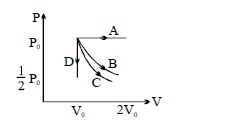
The $PV$ diagram shows four different possible reversible processes performed on a monatomic ideal gas. Process $A$ is isobaric (constant pressure). Process $B$ is isothermal (constant temperature). Process $C$ is adiabatic. Process $D$ is isochoric (constant volume). For which process$(es)$ does the temperature of the gas decrease?
  • AProcess $A$ only
  • BProcess $C$ only
  • COnly Processes $C$ and $D$
  • DOnly Processes $B$, $C$ and $D$
Medium
art

Download our app
and get started for free

Experience the future of education. Simply download our apps or reach out to us for more information. Let's shape the future of learning together!No signup needed.*

Similar Questions

  • 1
    A gas expands under constant pressure $P$ from volume ${V_1}$ to ${V_2}$. The work done by the gas is
    View Solution
  • 2
    A system performs work $\Delta W$ when an amount of heat is$\Delta Q$ added to the system, the corresponding change in the internal energy is $\Delta U$. A unique function of the initial and final states (irrespective of the mode of change) is
    View Solution
  • 3
    Six moles of an ideal gas perfomrs a cycle shown in figure. If the temperature are $T_A = 600 K, T_B = 800 K, T_C = 2200 K \,and\, T_D = 1200 K$, the work done per cycle is ..... $kJ$
    View Solution
  • 4
    An engine is supposed to operate between two reservoirs at temperature $727°C$ and $227°C.$ The maximum possible efficiency of such an engine is
    View Solution
  • 5
    A sample of ideal monoatomic gas is taken round the cycle $ABCA$ as shown in the figure. The work done during the cycle is
    View Solution
  • 6
    A scientist says that the efficiency of his heat engine which operates at source temperature $127°C$ and sink temperature $27°C$ is $26\%$, then
    View Solution
  • 7
    In the given $P$-V diagram, a monoatomic gas $\left(\gamma=\frac{5}{3}\right)$ is first compressed adiabatically from state $A$ to state $B$. Then it expands isothermally from state $B$ to state $C$. [Given: $\left(\frac{1}{3}\right)^{0.6} \simeq 0.5, \ln 2 \simeq 0.7$ ].

    Which of the following statement($s$) is(are) correct?

    $(A)$ The magnitude of the total work done in the process $A \rightarrow B \rightarrow C$ is $144 kJ$.

    $(B)$ The magnitude of the work done in the process $B \rightarrow C$ is $84 kJ$.

    $(C)$ The magnitude of the work done in the process $A \rightarrow B$ is $60 kJ$.

    $(D)$ The magnitude of the work done in the process $C \rightarrow A$ is zero.

    View Solution
  • 8
    A Carnot freezer takes heat from water at $0\,^oC$ inside it and rejects it to the room at a temperature of $27\,^oC$. The latent heat of ice is $336 \times 10^3\, J\,kg^{-1}$.  lf $5\, kg$ of water at $0\,^oC$ is converted into ice at  $0\,^oC$ by the freezer, then the energy consumed by the freezer is close to
    View Solution
  • 9
    For one complete cycle of a thermodynamic processes on a gas as shown in $P-V$ diagram. Which is true
    View Solution
  • 10
    The adjoining figure shows the $P-V$ diagram for a fixed mass of an ideal gas undergoing cyclic process. $AB$ represents isothermal process and $CA$ represents isochoric process.Which of the graph shown in the following figures represents the $P-T$ diagram of the cyclic process ?
    View Solution