The radiant energy from the sun incident normally at the surface of earth is $20\, \frac{{k\;cal}}{{{m^2}\;min}}$. What would have been the radiant energy incident normally on the earth, if the sun had a temperature twice of the present one ....... $kcal/m ^2 \,min$
AIPMT 1998, Medium


Download our appand get started for free
Experience the future of education. Simply download our apps or reach out to us for more information. Let's shape the future of learning together!No signup needed.*
Similar Questions
- 1A hot metallic sphere of radius $r$ radiates heat. It's rate of cooling isView Solution
- 2There is a rough black spot on a polished metallic plate. It is heated upto $1400 K$ approximately and then at once taken in a dark room. Which of the following statements is trueView Solution
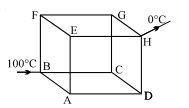
- 3Twelve conducting rods form the riders of a uniform cube of side $'l'.$ If in steady state, $B$ and $H$ ends of the rod are at $100^o C$ and $0^o C$. Find the temperature of the junction $'A'$ ....... $^oC$View Solution
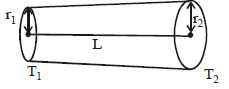
- 4The rate of heat flow through the cross-section of the rod shown in figure is ($T_2 > T_1$ and thermal conductivity of the material of the rod is $K$)View Solution
- 5The heat is flowing through two cylindrical rods of same material. The diameters of the rods are in the ratio $1 : 2$ and their lengths are in the ratio $2 : 1$ . If the temperature difference between their ends is the same, the ratio of rate of flow of heat through them will beView Solution
- 6In the Ingen Hauz’s experiment the wax melts up to lengths $10$ and $25 cm$ on two identical rods of different materials. The ratio of thermal conductivities of the two materials isView Solution
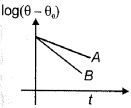
- 7Two bodies $A$ and $B$ of equal masses, area and emissivity cooling under Newton's law of cooling from same temperature are represented by the graph. If $\theta$ is the instantaneous temperature of the body and $\theta_0$ is the temperature of surroundings, then relationship between their specific heats is ..........View Solution
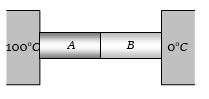
- 8Two metal cubes $A$ and $B$ of same size are arranged as shown in the figure. The extreme ends of the combination are maintained at the indicated temperatures. The arrangement is thermally insulated. The coefficients of thermal conductivity of $A$ and $B$ are $300\;W/m{\;^o}C$ and $200\;W/m{\;^o}C$, respectively. After steady state is reached, the temperature of the interface will be...... $^oC$View Solution
- 9At $127^o C$ radiates energy is $2.7 \times 10^{-3} J/s$. At ....... $K$ temperature radiated energy is $4.32 \times 10^6 J/s$View Solution
- 10Two identical objects $A$ and $B$ are at temperatures $T_A$ and $T_B$ respectively. Both objects are placed in a room with perfectly absorbing walls maintained at temperatures T $({T_A} > T > {T_B}).$ The objects A and B attain temperature $T $ eventually which one of the following is correct statementView Solution