$X $ and $Y$ are large, parallel conducting plates closed to each other. Each face has an area $A$. $X$ is given a charge $Q$. $Y$ is without any charge. Points $A, B$ and $C$ are as shown in figure.

Advanced
Download our app for free and get started
$q_{1}=q_{4}=\left(\frac{q_{\text {total }}}{2}=\frac{Q}{2}\right.$
$q_{2}=Q-q_{1}=\frac{Q}{2}$
$q_{3}=-q_{2}=\left(-\frac{Q}{2}\right)$
$E_{A}=E_{1}+E_{4}(\text { towards left })$
$=\frac{Q}{4 A \varepsilon_{0}}+\frac{Q}{4 A \varepsilon_{0}}=\frac{Q}{2 A \varepsilon_{0}}$
$E_{C}=-E_{A}(\text { towards right })$
$=\frac{Q}{2 A \varepsilon_{0}}$
$E_{B}=E_{2}+E_{3}(\text { towards right })$
$=\frac{Q}{4 A \varepsilon_{0}}+\frac{Q}{4 A \varepsilon_{0}}=\frac{Q}{2 A \varepsilon_{0}}$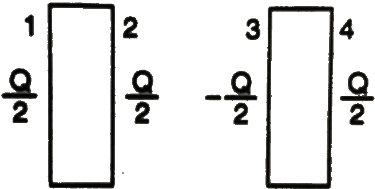

Download our appand get started for free
Experience the future of education. Simply download our apps or reach out to us for more information. Let's shape the future of learning together!No signup needed.*
Similar Questions
- 1If the electric potential at any point $(x, y, z) \,m$ in space is given by $V =3 x ^{2}$ volt. The electric field at the point $(1,0,3) \,m$ will be ............View Solution
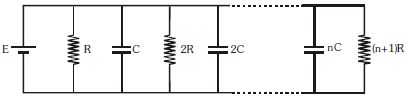
- 2For shown situation, in steady state condition ratio of charge stored in the first and last $n^{th}$ capacitor isView Solution
- 3A conducting sphere of radius a has charge $Q$ on it. It is enclosed by a neutral conducting concentric spherical shell having inner radius $2a$ and outer radius $3a.$ Find electrostatic energy of system.View Solution
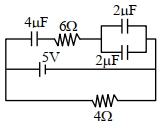
- 4Calculate the amount of charge on capacitor of $4\, \mu\, {F}$. The internal resistance of battery is $1\, \Omega$ : (in $\mu {C}$)View Solution
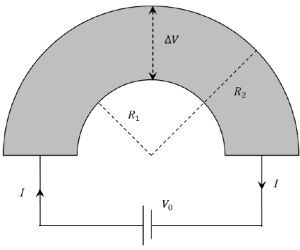
- 5Shown in the figure is a semicircular metallic strip that has thickness $t$ and resistivity $\rho$. Its inner radius is $R_1$ and outer radius is $R_2$. If a voltage $V_0$ is applied between its two ends, a current $I$ flows in it. In addition, it is observed that a transverse voltage $\Delta V$ develops between its inner and outer surfaces due to purely kinetic effects of moving electrons (ignore any role of the magnetic field due to the current). Then (figure is schematic and not drawn to scale)-View Solution
$(A)$ $I =\frac{V_0 t}{\pi \rho} \ln \left(\frac{R_2}{R_1}\right)$
$(B)$ the outer surface is at a higher voltage than the inner surface
$(C)$ the outer surface is at a lower voltage than the inner surface
$(D)$ $\Delta V \propto I ^2$
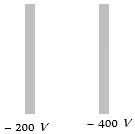
- 6View SolutionIn the following figure two parallel metallic plates are maintained at different potential. If an electron is released midway between the plates, it will move
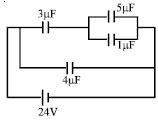
- 7In the circuit shown, the energy stored in $1$ $ \mu F$ capacitor is......$\mu J$View Solution
- 8The capacitor of capacitance $4\,\mu F$ and $6\,\mu F$ are connected in series. A potential difference of $500\;volts$ applied to the outer plates of the two capacitor system. Then the charge on each capacitor is numericallyView Solution
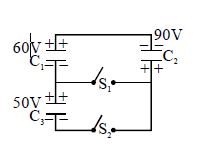
- 9Three charged capacitors, $C_1$ = $17\ μF$, $C_2$ = $34\ μF$, $C_3$ = $41\ μF$and two open switches, $S_1$ and $S_2$ are assembled into a network with initial voltages and polarities, as shown. Final status of the network is attained when the two switches, $S_1$ and $S_2$ are closed. In the figure, the final charge on capacitor $C_3$ in $mC$, is closet to:View Solution
- 10A point electric dipole placed at the origin has a potential given by $V(r, \theta)=\frac{p \cos \theta}{4 \pi \varepsilon_0 r^2}$, where $\theta$ is the angle made by the position vector with the direction of the dipole. Then,View Solution