The radius of curvature of the path of the charged particle in a uniform magnetic field is directly proportional to
Easy


Download our appand get started for free
Experience the future of education. Simply download our apps or reach out to us for more information. Let's shape the future of learning together!No signup needed.*
Similar Questions
- 1Consider the motion of a positive point charge in a region where there are simultaneous uniform electric and magnetic fields $\vec{E}=E_0 \hat{j}$ and $\vec{B}=B_0 \hat{j}$. At time $t=0$, this charge has velocity $\nabla$ in the $x$-y plane, making an angle $\theta$ with $x$-axis. Which of the following option$(s)$ is(are) correct for time $t>0$ ?View Solution
$(A)$ If $\theta=0^{\circ}$, the charge moves in a circular path in the $x-z$ plane.
$(B)$ If $\theta=0^{\circ}$, the charge undergoes helical motion with constant pitch along the $y$-axis.
$(C)$ If $\theta=10^{\circ}$, the charge undergoes helical motion with its pitch increasing with time, along the $y$-axis.
$(D)$ If $\theta=90^{\circ}$, the charge undergoes linear but accelerated motion along the $y$-axis.
- 2Which one of the following options represents the magnetic field $\vec{B}$ at $O$ due to the current flowing in the given wire segments lying on the $x y$ plane?View Solution
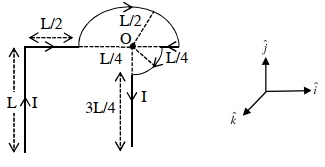
- 3A proton and an $\alpha - $particle enter a uniform magnetic field perpendicularly with the same speed. If proton takes $25$ $\mu \, sec$ to make $5$ revolutions, then the periodic time for the $\alpha - $ particle would be........$\mu \, sec$View Solution
- 4An electron, a proton, a deuteron and an alpha particle, each having the same speed are in a region of constant magnetic field perpendicular to the direction of the velocities of the particles. The radius of the circular orbits of these particles are respectively $R_e, R_p, R_d \,$ and $\, R_\alpha$. It follows thatView Solution
- 5Currents of a $10\, ampere$ and $2\, ampere$ are passed through two parallel thin wires $A$ and $B$ respectively in opposite directions. Wire $A$ is infinitely long and the length of the wire $B$ is $2\, m$. The force acting on the conductor $B$, which is situated at $10\, cm$ distance from $A$ will beView Solution
- 6Two long straight wires $P$ and $Q$ carrying equal current $10\,A$ each were kept parallel to each other at $5\,cm$ distance. Magnitude of magnetic force experienced by $10\,cm$ length of wire $P$ is $F_1$. If distance between wires is halved and currents on them are doubled, force $F_2$ on $10\,cm$ length of wire $P$ will be :View Solution
- 7A long solenoid of $50\, cm$ length having $100$ turns carries a current of $2.5$ $A.$ The magnetic field at the centre of the solenold is $...... \times 10^{-5}\;T$View Solution
$\left(\mu_{0}=4 \pi \times 10^{-7}\, T\, m\, A ^{-1}\right)$
- 8View SolutionChoose the correct statement
- 9View SolutionThe magnetic field at the origin due to the current flowing in the wire is -
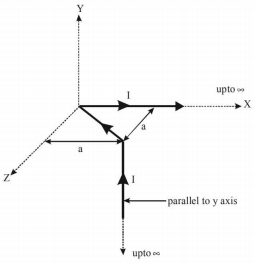
- 10The resistance of a galvanometer is $50\,\Omega $ and it requires $2\,\mu A$ per two division deflection. The value of the shunt required in order to convert this galvanometer into ammeter of range $5\,A$ is (The number of divisions on the galvanometer scale on one side is $30$)View Solution