In the electric field of a point charge $q$, a certain charge is carried from point $A$ to $B, C, D$ and $E$. Then the work done
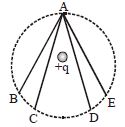
Easy


Download our appand get started for free
Experience the future of education. Simply download our apps or reach out to us for more information. Let's shape the future of learning together!No signup needed.*
Similar Questions
- 1An air capacitor of capacity $C = 10\,\mu F$ is connected to a constant voltage battery of $12\,V$. Now the space between the plates is filled with a liquid of dielectric constant $5$. The charge that flows now from battery to the capacitor is......$\mu C$View Solution
- 2Two uniformly charged spherical conductors $A$ and $B$ of radii $5 mm$ and $10 mm$ are separated by a distance of $2 cm$. If the spheres are connected by a conducting wire, then in equilibrium condition, the ratio of the magnitudes of the electric fields at the surface of the sphere $A$ and $B$ will be .View Solution
- 3Two capacitances of capacity ${C_1}$ and ${C_2}$ are connected in series and potential difference $V$ is applied across it. Then the potential difference across ${C_1}$ will beView Solution
- 4View SolutionA parallel plate capacitor has a parallel sheet of copper inserted between and parallel to the two plates, without touching the plates. The capacity of the capacitor after the introduction of the copper sheet is :
- 5Two tiny electric dipoles of dipole moment $P_1$ and $P_2$ are placed $'r'$ distance coaxially find magnitude of electrostatic force between them.View Solution
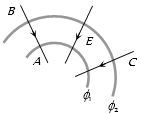
- 6In moving from $A$ to $B$ along an electric field line, the electric field does $6.4 \times {10^{ - 19}}\,J$ of work on an electron. If ${\phi _1},\;{\phi _2}$ are equipotential surfaces, then the potential difference $({V_C} - {V_A})$ is.....$V$View Solution
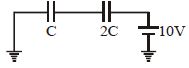
- 7In the circuit shown in the figure, $C = 6\,\mu F$. The charge stored in the capacitor of capacity $C$ is..........$\mu C$View Solution
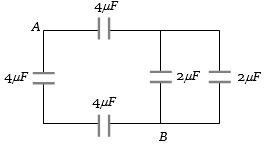
- 8In the circuit as shown in the figure the effective capacitance between $A$ and $B$ is........$\mu \,F$View Solution
- 9Positive and negative point charges of equal magnitude are kept at $\left(0,0, \frac{a}{2}\right)$ and $\left(0,0, \frac{-a}{2}\right)$, respectively. The work done by the electric field when another positive point charge is moved from $(-a, 0,0)$ to $(0, a, 0)$ isView Solution
- 10A $5.0\, \mu F$ capacitor is charged to a potential difference $800\, V$ and discharged through a conductor. The energy(in $J$) given to a conductor during the discharge isView Solution