MCQ
The radius of the orbit of a satellite is $r$ and its kinetic energy is $K.$ If the radius of the orbit is doubled, then the new kinetic energy $K'$ is:
  • A
    $2$
  • $\frac{\text{K}}{2}$
  • C
    $4K$
  • D
    Data insufficient.

Answer

Correct option: B.
$\frac{\text{K}}{2}$

Need a full question paper?

Generate a complete, print-ready paper with questions like this in minutes — across 16+ boards, with answer keys.

Start Generating Free

Similar questions

A body is performing simple harmonic with an amplitude of $10 \,cm$. The velocity of the body was tripled by air Jet when it is at $5 \,cm$ from its mean position. The new amplitude of vibration is $\sqrt{ x } \,cm$. The value of $x$ is________
$Assertion :$ The time-period of pendulum, on a satellite orbiting the earth is infinity.
$Reason :$ Time-period of a pendulum is inversely proportional to $\sqrt g$
One mole of an ideal monoatomic gas undergoes the following four reversible processes:

Step $1$ It is first compressed adiabatically from volume $V_{1}$ to $1 \;m ^{3}$.

Step $2$ Then expanded isothermally to volume $10 \;m ^{3}$.

Step $3$ Then expanded adiabatically to volume $V _{3}$.

Step $4$ Then compressed isothermally to volume $V_{1}$. If the efficiency of the above cycle is $3 / 4$, then $V_{1}$ is ............ $m^3$
A motor cyclist moving with a velocity of $72\, km/hour$ on a flat road takes a turn on the road at a point where the radius of curvature of the road is $20$ meters. The acceleration due to gravity is $10 m/sec^2$. In order to avoid skidding, he must not bend with respect to the vertical plane by an angle greater than
A ball of mass m moves with speed $v$ and it strikes normally with a wall and reflected back normally, if its time of contact with wall is $t$ then find force exerted by ball on wall
A stone is allowed to fall from the top of a tower $100\,\,metre$  high and at the same time another stone is projected vertically upwards from the ground with a velocity of $25\,\,ms^{-1}.$  The two stones will meet after.........$s$
Absolute scale of temperature is reproduced in the laboratory by making use of a
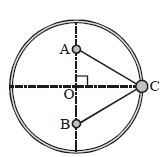
A bead of mass $m$ can slide on a frictionless fixed ring of very large radius $r$. With the help of two identical strings of force constant $k,$ it is connected to two diametrically opposite nails $A$ and $B$ each of which are at distance $0.5r$ from the centre $O$ of the ring. The relaxed length of each string is negligible as compared to the radius of the ring. The bead is given a small velocity. What can you predict for further motion of the bead before any of the strings strikes a nail?
Keeping the number of moles, volume and temperature the same, which of the following are the same for all ideal gases?
A satellite of mass $m$, initially at rest on the earth, is launched into a circular orbit at a height equal to the radius of the earth. The minimum energy required is