MCQ
The rate of diffusion is
  • A
    Faster in solids than in liquids and gases
  • B
    Faster in liquids than in solids and gases
  • C
    Equal to solids, liquids and gases
  • Faster in gases than in liquids and solids

Answer

Correct option: D.
Faster in gases than in liquids and solids
d
because of low density 

Need a full question paper?

Generate a complete, print-ready paper with questions like this in minutes — across 16+ boards, with answer keys.
Start Generating Free

Similar questions

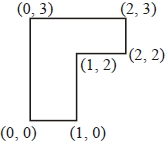
The coordinates of centre of mass of a uniform flag shaped lamina (thin flat plate) of mass $4\;kg$. (The coordinates of the same are shown in figure) are
A body moves with velocity $v,\,\,2v$ and $3v$  in the first, second and third, one third distance of path travelled. Its average speed is
In the context of accuracy of measurement and significant figures in expressing results of experiment, which of the following is/are correct

$(1)$ Out of the two measurements $50.14 \,cm$ and $0.00025$ ampere, the first one has greater accuracy

$(2)$ If one travels $478\, km$ by rail and $397\, m$. by road, the total distance travelled is $478\, km.$
Which graph represents the variation of surface tension with temperature over small temperature ranges for water
A solid cylinder rolls down an inclined plane from a height $h$. At any moment the ratio of rotational kinetic energy to the total kinetic energy would be 
When vapour condenses into liquid
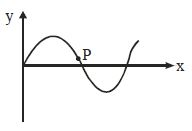
A transverse sinusoidal wave moves along a string in the positive $x-$ direction at a speed of $10\, cm/s$. The wavelength of the wave is $0.5\, m$ and its amplitude is $10\, cm$. At a prticular time $t$, the snap-shot of the wave is shown in the figure. the velocity of point $P$ when its displacement is $5\, cm$, is 
Ten tuning forks are arranged in increasing order of frequency in such a way that any two consecutive tuning forks produce $4$ beats per second. The highest frequency is twice that of the lowest. Possible highest and lowest frequencies (in $Hz$ ) are ................
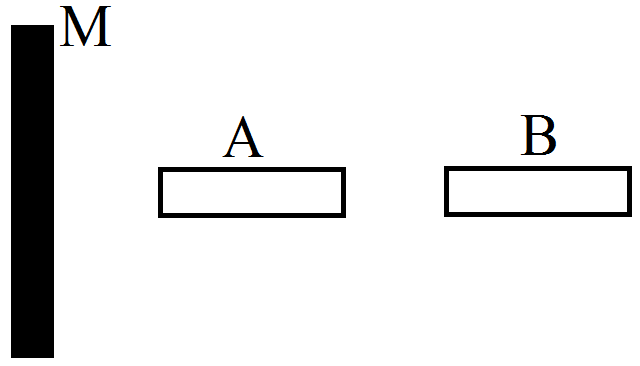
A large nonconducting sheet M is given a uniform charge density. Two uncharged small metal rods A and B are placed near the sheet as shown in figure:
  1. M attracts A.
  2. M attracts B.
  3. A attracts B.
  4. B attracts A.

$r.m.s.$ velocity of nitrogen molecules at $NTP$ is ...... $m/s$