The rate of steady volume flow of water through a capillary tube of length $ 'l' $ and radius $ 'r' $ under a pressure difference of $P$ is $V$. This tube is connected with another tube of the same length but half the radius in series. Then the rate of steady volume flow through them is (The pressure difference across the combination is $ P$)
Diffcult


Download our appand get started for free
Experience the future of education. Simply download our apps or reach out to us for more information. Let's shape the future of learning together!No signup needed.*
Similar Questions
- 1Water is flowing through a tube of non-uniform cross-section ratio of the radius at entry and exit end of the pipe is $ 3 : 2.$ Then the ratio of velocities at entry and exit of liquid isView Solution
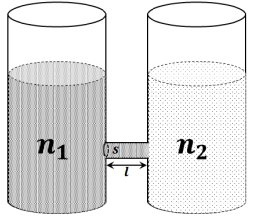
- 2As shown schematically in the figure, two vessels contain water solutions (at temperature $T$ ) of potassium permanganate $\left( KMnO _4\right)$ of different concentrations $n_1$ and $n_2\left(n_1>n_2\right)$ molecules per unit volume with $\Delta n=\left(n_1-n_2\right) \ll n_1$. When they are connected by a tube of small length $\ell$ and cross-sectional area $S , KMnO _4$ starts to diffuse from the left to the right vessel through the tube. Consider the collection of molecules to behave as dilute ideal gases and the difference in their partial pressure in the two vessels causing the diffusion. The speed $v$ of the molecules is limited by the viscous force $-\beta v$ on each molecule, where $\beta$ is a constant. Neglecting all terms of the order $(\Delta n)^2$, which of the following is/are correct? ( $k_B$ is the Boltzmann constant)-View Solution
$(A)$ the force causing the molecules to move across the tube is $\Delta n k_B T S$
$(B)$ force balance implies $n_1 \beta v \ell=\Delta n k_B T$
$(C)$ total number of molecules going across the tube per sec is $\left(\frac{\Delta n}{\ell}\right)\left(\frac{k_B T}{\beta}\right) S$
$(D)$ rate of molecules getting transferred through the tube does not change with time
- 3Two cyllinders of same cross-section and length $L$ but made of two material of densities $d_1$ and $d_2$ are cemented together to form a cylinder of length $2L$. The combination floats in a liquid of density $d$ with $a$ length $L/2$ above the surface of the liquid. If $d_1 > d_2$ then:View Solution
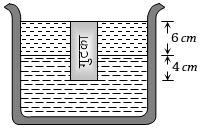
- 4A cubical block of wood $10 \,cm$ on a side floats at the interface between oil and water with its lower surface horizontal and $4\, cm$ below the interface. The density of oil is $0.6gc{m^{ - 3}}$. The mass of block is ...... $gm$View Solution
- 5Water falls down a $500.0 \,m$ shaft to reach a turbine which generates electricity. ................ $m^3$ water must fall per second in order to generate $1.00 \times 10^9 \,W$ of power ? (Assume $50 \%$ efficiency of conversion and $\left.g=10 \,ms ^{-2}\right)$View Solution
- 6The vertical limbs of a $U$ shaped tube are filled with a liquid of density $\rho$ upto a height $h$ on each side. The horizontal portion of the $U$ tube having length $2h$ contains a liquid of density $2\rho$ . The $U$ tube is moved horizontally with an accelerator $g/2$ parallel to the horizontal arm. The difference in heights in liquid levels in the two vertical limbs, at steady state will beView Solution
- 7If a ball of steel (density $\rho=7.8 \;gcm ^{-3}$) attains a terminal velocity of $10 \;cms ^{-1}$ when falling in a tank of water (coefficient of viscosity $\eta_{\text {water }}=8.5 \times 10^{-4} \;Pa - s$ ) then its terminal velocity in glycerine $\left(\rho=12 gcm ^{-3}, \eta=13.2\right)$ would be nearlyView Solution
- 8A thin uniform cylindrical shell, closed at both ends, is partially filled with water. It is floating vertically in water in half-submerged state. If $\rho_0$ is the relative density of the material of the shell with respect to water, then the correct statement is that the shell isView Solution
- 9A metal ball of density $7800\ kg/m^3$ is suspected to have a large number of cavities . It weighs $9.8$ $kg$ when weighed directly on a balance and $1.5$ $kg$ less when immersed in water . The fraction by volume of the cavities in the metal ball is approximately ....... $\%$View Solution
- 10A wooden cube just floats inside water with a $200 \,gm$ mass placed on it. When the mass is removed, the cube floats with its top surface $2 \,cm$ above the water level. the side of the cube is ......... $cm$View Solution