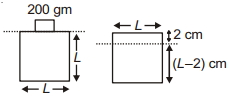
A wooden cube just floats inside water with a $200 \,gm$ mass placed on it. When the mass is removed, the cube floats with its top surface $2 \,cm$ above the water level. the side of the cube is ......... $cm$
Medium


Download our appand get started for free
Experience the future of education. Simply download our apps or reach out to us for more information. Let's shape the future of learning together!No signup needed.*
Similar Questions
- 1A tank is filled with water of density $1\,g$ per $cm^3$ and oil of density $0.9\,g$ per $cm^3$ . The height of water layer is $100\,cm$ and of the oil layer is $400\,cm.$ If $g = 980\,cm/sec^2,$ then the velocity of efflux from an opening in the bottom of the tank isView Solution
- 2Water flows steadily through a horizontal pipe of variable cross-section. If the pressure of water is $P$ at a point where flow speed is $v$ , the pressure at another point where the flow speed is $2v$ , is (Take density of water as $\rho $ )View Solution
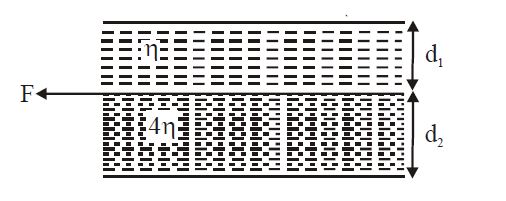
- 3A thin plate separates two liquids of coefficients of viscosity $\eta$ and $4\ \eta$ kept between two fixed plates as shown. If plate has to be pulled by applying minimum force then $\frac{d_2}{d_1}$ isView Solution
- 4Three liquids of densities $d,\,2d$ and $3d$ are mixed in equal volumes. Then the density of the mixture isView Solution
- 5Water flows into a large tank with flat bottom at the rate of ${10^{ - 4}}\,{m^3}{s^{ - 1}}$. Water is also leaking out of a hole of area $1\, cm^2$ at its bottom. If the height of the water in the tank remains steady, then this height is........ $cm$View Solution
- 6A submarine experiences a pressure of $5.05\times 10^6\,Pa$ at a depth of $d_1$ in a sea. When it goes further to a depth of $d_2,$ it experiences a pressure of $8.08\times 10^6\,Pa.$ Then $d_2 -d_1$ is approximately ........ $m$ (density of water $= 10^3\,kg/m^3$ and acceleration due to gravity $= 10\,ms^{-2}$ )View Solution
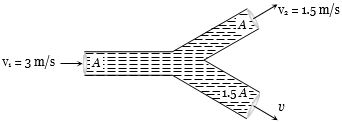
- 7An incompressible liquid flows through a horizontal tube as shown in the following fig. Then the velocity $ v$ of the fluid is .......$m/s$View Solution
- 8There is a hole of area $A$ at the bottom of cylindrical vessel. Water is filled up to a height $ h$ and water flows out in $ t $ second. If water is filled to a height $4h,$ it will flow out in time equal toView Solution
- 9The blades of a windmill sweep out a circle of area $A$. If the wind flows at a velocity $b$ perpendicular to the circle, then the mass of the air of density $\rho $ passing through it in time $t$ isView Solution
- 10A spherical ball of radius $1 \times 10^{-4} \mathrm{~m}$ and density $10^5$ $\mathrm{kg} / \mathrm{m}^3$ falls freely under gravity through a distance $h$ before entering a tank of water, If after entering in water the velocity of the ball does not change, then the value of $h$ is approximately:View Solution
(The coefficient of viscosity of water is $9.8 \times 10^{-6}$ $\left.\mathrm{N} \mathrm{s} / \mathrm{m}^2\right)$