MCQ
The ratio of distances covered by a freely falling object in its first and second second is:
  • A
    $1: 2$
  • $1: 3$
  • C
    $3: 2$
  • D
    $1: \sqrt{3}$

Answer

Correct option: B.
$1: 3$
 (b) Distance covered in $n ^{\text {th }}$ second
$\begin{array}{rlr} s _{ n } & = u +\frac{1}{2} a (2 n -1) &
\\ s _1 & =0+\frac{1}{2} a & ( n =1)
\\ s _2 & =0+\frac{3}{2} a \\ s _1: s _2 & =1: 3 & ( n =2)\end{array}$
Hence the correct option is (b).

Need a full question paper?

Generate a complete, print-ready paper with questions like this in minutes — across 16+ boards, with answer keys.

Start Generating Free

Similar questions

A hot black body emits the energy at the rate of $16\ J\ m^{-2}\ s^{-1}$ and its most intense radiation corresponds to $20,000\ Å$ . When the temperature of this body is further increased and its most intense radiation corresponds to $10,000\ Å$ , then the energy radiated in $Jm^{-2}\ s^{-1}$ will be
A bullet of mass m fired at $30^\circ$ to the horizontal leaves the barrel of the gun with a velocity $v.$ The bullet hits a soft target at a height h above the ground while it is moving downward and emerges out with half the kinetic energy it had before hitting the target. Which of the following statements are correct in respect of bullet after it emerges out of the target?
A bomb of mass $9 \,kg$ explodes into two pieces of masses $3 \,kg$ and $6 \,kg$. The velocity of mass $3 \,kg$ is $16 \,m / s$. The kinetic energy of mass $6 \,kg$ in joule is
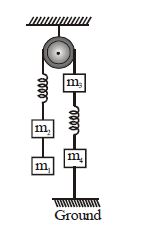
For the system shown in figure, $m_1>m_2>m_3 >m_4$ . Initially, the system is at rest in equilibrium condition. If the string joining $m_4$ and ground is cut, then just after the string is cut :

Statement $I$ $m_1$ ,$m_2$ ,$m_3$ remain stationary.

Statement $II$ The value of acceleration of all the $4$ blocks can be determined.

Statement $III$ Only $m_4$ remains stationary.

Statement $IV$ Only $m_4$ accelerates.

Statement $V$ All the four blocks remain stationary.

Now, choose the correct option.
A particle of mass $m$ starts moving from origin along $x$-axis and its velocity varies with position $(x)$ as $v=k \sqrt{x}$. The work done by force acting on it during first " $t$ " seconds is ...........
An organ pipe $P_1$ closed at one end vibrating in its first overtone. Another pipe $P_2$ open at both ends is vibrating in its third overtone. They are in a resonance with a given tuning fork. The ratio of the length of $P_1$ to that of $P_2$ is
There are $100$ divisions on the circular scale of a screw gauge of pitch $1 \mathrm{~mm}$. With no measuring quantity in between the jaws, the zero of the circular scale lies $5$ divisions below the reference line. The diameter of a wire is then measured using this screw gauge. It is found the $4$ linear scale divisions are clearly visible while $60$ divisions on circular scale coincide with the reference line. The diameter of the wire is :
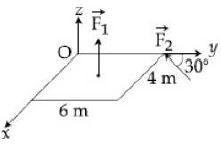
A slab is subjected to the two forces ${\vec F_1}$ and ${\vec F_2}$ of same magnitude $F$ as shown in the figure. Force  ${\vec F_2}$ is in $XY -$ plane while force $F_1$ acts along $z -$ axis at the point $(2\vec i + 3\vec j)$.  The moment of these forces about point $O$ will be
The viscous force acting between two layers of a liquid is given by $\frac{\text{F}}{\text{A}}=-\eta\frac{\text{dv}}{\text{dz}}$ This $\frac{\text{F}}{\text{A}}$ may be called:
$110J$ of heat are added to a gaseous system and its internal energy increases by $40J,$ then the amount of work done is: