Three waves of equal frequency having amplitudes $10 \,\mu \, m, 4 \, \mu \,m$ and $7 \mu m$ arrive at a given point with successive phase difference of $\frac{\pi }{2}$. The amplitude of the resulting wave in $\mu \,m$ is given by
AIIMS 1995, Medium
Download our app for free and get started
(c) The wave $1$ and $3$ reach out of phase. Hence resultant phase difference between them is $\pi $.
$\therefore $ Resultant amplitude of $1$ and $3 = 10 - 7 = 3 \mu m$
This wave has phase difference of $\frac{\pi }{2}$ with $4 \mu m$
$\therefore $ Resultant amplitude = $\sqrt {{3^2} + {4^2}} = 5\,\,\mu m$

Download our appand get started for free
Experience the future of education. Simply download our apps or reach out to us for more information. Let's shape the future of learning together!No signup needed.*
Similar Questions
- 1An observer receives waves directly from a source of sound distant $120\,m$ in a big hall. He also receives waves reflected from the mid-point of $25\,m$ high ceiling. The wavelength of sound for constructive interference to take place between two waves, must be :View Solution
- 2The length of a sonometer wire is $0.75\, m$ and density $9 \times 10^3\, kg/m^3$. It can bear a stress of $8.1 \times 10^8\, N/m^2$ without exceeding the elastic limit. What is the fundamental frequency that can be produced in the wire .... $Hz$ ?View Solution
- 3A stationary observer receives sound from two identical tuning forks, one of which approaches and the other one recedes with the same speed (much less than the speed of sound). The observer hears $2\; beats/sec$. The oscillation frequency of each tuning fork is $v_{0}=1400 \;\mathrm{Hz}$ and the velocity of sound in air is $350\; \mathrm{m} / \mathrm{s}$. The speed of each tuning fork is close toView Solution
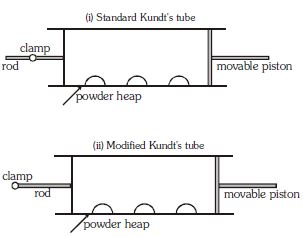
- 4In the Kundts tube experiment (shown in fig. $(i)$), the rod is clamped at the end instead of clamping it at the center as shown in fig. $(ii).$ It is known that speed of sound in air is $330\ m/s$, powder piles up at successive distance of $0.6\ m$ and length of rod used is $1\ m$, speed of sound in rod is .... $\frac{m}{s}$View Solution
- 5A wire of density $8 \times 10^3\,kg / m ^3$ is stretched between two clamps $0.5\,m$ apart. The extension developed in the wire is $3.2 \times 10^{-4}\,m$. If $Y =8 \times 10^{10}\,N / m ^2$, the fundamental frequency of vibration in the wire will be $......\,Hz$.View Solution
- 6A stretched string of $1m$ length and mass $5 \times {10^{ - 4}}kg$ is having tension of $20N.$ If it is plucked at $25cm$ from one end then it will vibrate with frequency ... $Hz$View Solution
- 7View SolutionSound waves of wavelength greater than that of audible sound are called
- 8The intensity of sound after passing through a slab decreases by $30\%$. On passing through two such slabs, the intensity will decrease by ..... $\%$View Solution
- 9Two identical flutes produce fundamental notes of frequency $300 Hz$ at ${27^o} C.$ If the temperature of air in one flute is increased to ${31^o}$C, the number of the beats heard per second will beView Solution
- 10A car moves towards a hill with speed $v_c$. It blows a horn of frequency $f$ which is heared by an observer following the car with speed $v_0$. The speed of sound in air is $v$.View Solution