The ratio of intensities between two coherent sound sources is $4: 1$. The difference of loudness in dB between maximum and minimum intensities when they interfere in the space is ..........
Medium
Download our app for free and get started
(c)
Loudness in $dB =10 \log _{10} \frac{I}{I_0}$
Let $L_1=10 \log _{10} \frac{l}{I_0}$
$L_2=10 \log _{10} \frac{4 I}{I_0}$
$L_2-L_1=10 \log _{10} 4$
$=20 \log _{10} 2$

Download our appand get started for free
Experience the future of education. Simply download our apps or reach out to us for more information. Let's shape the future of learning together!No signup needed.*
Similar Questions
- 1The equation $y = A{\cos ^2}\left( {2\pi \;nt - 2\pi \frac{x}{\lambda }} \right)$ represents a wave withView Solution
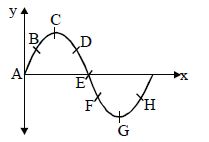
- 2View SolutionA transverse wave is travelling along a string from left to right. The adjoining figure represents the shape of the string at a given instant. At this instant, among the following, choose the wrong statement.
- 3The ratio of intensities between two coherent soud sources is $4 : 1$. The differenmce of loudness in $dB$ between maximum and minimum intensities when they interfere in space is:View Solution
- 4Answer the following by appropriately matching the lists based on the information given in the paragraph.A musical instrument is made using four different metal strings, $1,2,3$ and $4$ with mass per unit length $\mu, 2 \mu, 3 \mu$ and $4 \mu$ respectively. The instrument is played by vibrating the strings by varying the free length in between the range $L _0$ and $2 L _0$. It is found that in string$-1 \ (\mu)$ at free length $L _0$ and tension $T _0$ the fundamental mode frequency is $f _0$.View Solution
List $-I$ gives the above four strings while list $-II$ lists the magnitude of some quantity.
($1$) If the tension in each string is $T _0$, the correct match for the highest fundamental frequency in $f _0$ units will be,List $-I$ List $-II$ $(I)$ String $-1( \mu$ ) $(P) 1$ $(II)$ String $-2 (2 \mu)$ $(Q)$ $1 / 2$ $(III)$ String $-3 (3 \mu)$ $(R)$ $1 / \sqrt{2}$ $(IV)$ String $-4 (4 \mu)$ $(S)$ $1 / \sqrt{3}$ $(T)$ $3 / 16$ $(U)$ $1 / 16$
$(1)$ $I \rightarrow P , II \rightarrow R , III \rightarrow S , IV \rightarrow Q$
$(2)$ $I \rightarrow P , II \rightarrow Q , III \rightarrow T , IV \rightarrow S$
$(3)$ $I \rightarrow Q , II \rightarrow S , III \rightarrow R , IV \rightarrow P$
$(4)$ I $\rightarrow Q , II \rightarrow P , III \rightarrow R$, IV $\rightarrow T$
($2$) The length of the string $1,2,3$ and 4 are kept fixed at $L _0, \frac{3 L _0}{2}, \frac{5 L _0}{4}$ and $\frac{7 L _0}{4}$, respectively. Strings $1,2,3$ and 4 are vibrated at their $1^{\text {tt }}, 3^{\text {rd }}, 5^{\text {m }}$ and $14^{\star}$ harmonics, respectively such that all the strings have same frequency. The correct match for the tension in the four strings in the units of $T _0$ will be.
$(1)$ $I \rightarrow P , II \rightarrow Q , III \rightarrow T , IV \rightarrow U$
$(2)$ $I \rightarrow T , II \rightarrow Q , III \rightarrow R$, IV $\rightarrow U$
$(3)$ $I \rightarrow P , II \rightarrow Q , III \rightarrow R , IV \rightarrow T$
$(4)$ I $\rightarrow P , II \rightarrow R , III \rightarrow T , IV \rightarrow U$ - 5A standing wave exists in a string of length $150\ cm$ , which is fixed at both ends with rigid supports . The displacement amplitude of a point at a distance of $10\ cm$ from one of the ends is $5\sqrt 3\ mm$ . The nearest distance between the two points, within the same loop and havin displacment amplitude equal to $5\sqrt 3\ mm$ is $10\ cm$ . Find the maximum displacement amplitude of the particles in the string .... $mm$View Solution
- 6A tuning fork with frequency $800 \;\mathrm{Hz}$ produces resonance in a resonance column tube with upper end open and lower end closed by water surface. Surface. Successive resonance are observed at length $9.75 \;\mathrm{cm}, 31.25\; \mathrm{cm}$ and $52.75\; \mathrm{cm} .$ The speed of sound in air is ......$m/s$View Solution
- 7When a tuning fork of frequency $341$ is sounded with another tuning fork, six beats per second are heard. When the second tuning fork is loaded with wax and sounded with the first tuning fork, the number of beats is two per second. The natural frequency of the second tuning fork isView Solution
- 8A source of sound $S$ of frequency $500 Hz$ situated between a stationary observer $O$ and a wall $W$, moves towards the wall with a speed of $2 m/s$. If the velocity of sound is $332 m/s$, then the number of beats per second heard by the observer is (approximately)View Solution
- 9Each of the properties of sound listed in column $A$ primarily depends on one of the quantities in column $B$. Choose the matching pairs from two columnsView Solution
Column $A$ Column $B$
Pitch Waveform
Quality Frequency
Loudness Intensity
- 10An organ pipe $P_1$, closed at one end vibrating in its first harmonic and another pipe $P_2$, open at both ends vibrating in its third harmonic, are in resonance with a given tuning fork, The ratio of the lengths of $P_1$ and $P_2$ isView Solution