- A$500\, m/s^2$
- ✓$500\,\sqrt 2 \,m/{s^2}$
- C$750\, m/s^2$
- D$750\,\sqrt 2 \,m/{s^2}$
$x=a \sin (\omega t+\pi t 4)$
at $t=0, x=5$
$5=a \sin \pi / 4$
$5=a \sin 45^{\circ} \Rightarrow a=5 \sqrt{2}$
Maximum acceleration $\mathrm{A}_{\mathrm{max}}=\mathrm{a} \omega^{2}$
$=500\sqrt{2}\,m/s^2$
Generate a complete, print-ready paper with questions like this in minutes — across 16+ boards, with answer keys.
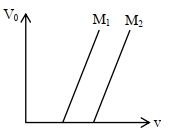
Statement-$I$: Figure shows the variation of stopping potential with frequency $(v)$ for the two photosensitive materials $M_1$ and $M_2$. The slope gives value of $\frac{h}{e}$, where $h$ is Planck's constant, $e$ is the charge of electron.
Statement-$II$: $M_2$ will emit photoelectrons of greater kinetic energy for the incident radiation having same frequency.
In the light of the above statements, choose the most appropriate answer from the options given below.
Assertion $A:$ Two metallic spheres are charged to the same potential. One of them is hollow and another is solid, and both have the same radii. Solid sphere will have lower charge than the hollow one.
Reason $R:$ Capacitance of metallic spheres depend on the radii of spheres.
In the light of the above statements, choose the correct answer from the options given below.
